
CDR Report for Electronics Engineers: Requirements, Process & Mistakes
11 minute read
Publish date: 2026/04/16
Many electronics engineers struggle to present their academic projects and work experience in a way that matches the expectations of Engineers Australia. Turning technical work into structured career episodes and linking it to required competencies often becomes challenging.
Small gaps in explaining roles, responsibilities, or engineering decisions can affect how the application gets reviewed. Focus on real projects, clearly explain individual contributions, and connect each task to the required competency elements.
In this blog, you will learn what a CDR report includes, why it is required, and how to prepare it under ANZSCO 233411.
What Is a CDR Report for Electronics Engineers?
A CDR (Competency Demonstration Report) shows how an electronics engineer’s education and work experience meet the requirements for migration to Australia under ANZSCO 233411. This report is assessed by Engineers Australia to determine whether the profile meets the required engineering standards.
A complete CDR report includes four main parts. A CV gives an overview of education and work history. A CPD list shows ongoing learning and skill development. Career Episodes explain real projects, including the tasks performed and technical decisions made. A Summary Statement connects the work from those projects to the required engineering competencies.
Why Do Electronics Engineers Need a CDR Report?
Electronics engineers use a CDR report to support the skills assessment requirement, show engineering work, and explain technical skills through real project examples. It also helps move the application forward in the process and prove readiness for electronics engineering roles.
- Skills Assessment Requirement: Makes it easier to assess whether the education and work experience meet the expected level for electronics engineers in Australia. It also gives a complete view of the applicant’s background beyond academic qualifications.
- Show Engineering Work: Presents real projects handled by the engineer, making it easier for assessors to understand the type of work completed and the exact role in each project. It also gives assessors a clear view of practical experience beyond theoretical knowledge.
- Explain Technical Skills: Shows how engineering tasks were completed, including the methods used, tools applied, and decisions made during the work. It helps assessors understand how technical knowledge is applied in real situations.
- Move Forward in Process: Allows the application to move to the next stage of the skilled migration process after a positive CDR result. Without it, assessors cannot proceed with the application for roles under ANZSCO 233411.
What Are the ANZSCO 233411 Requirements for Electronics Engineers?
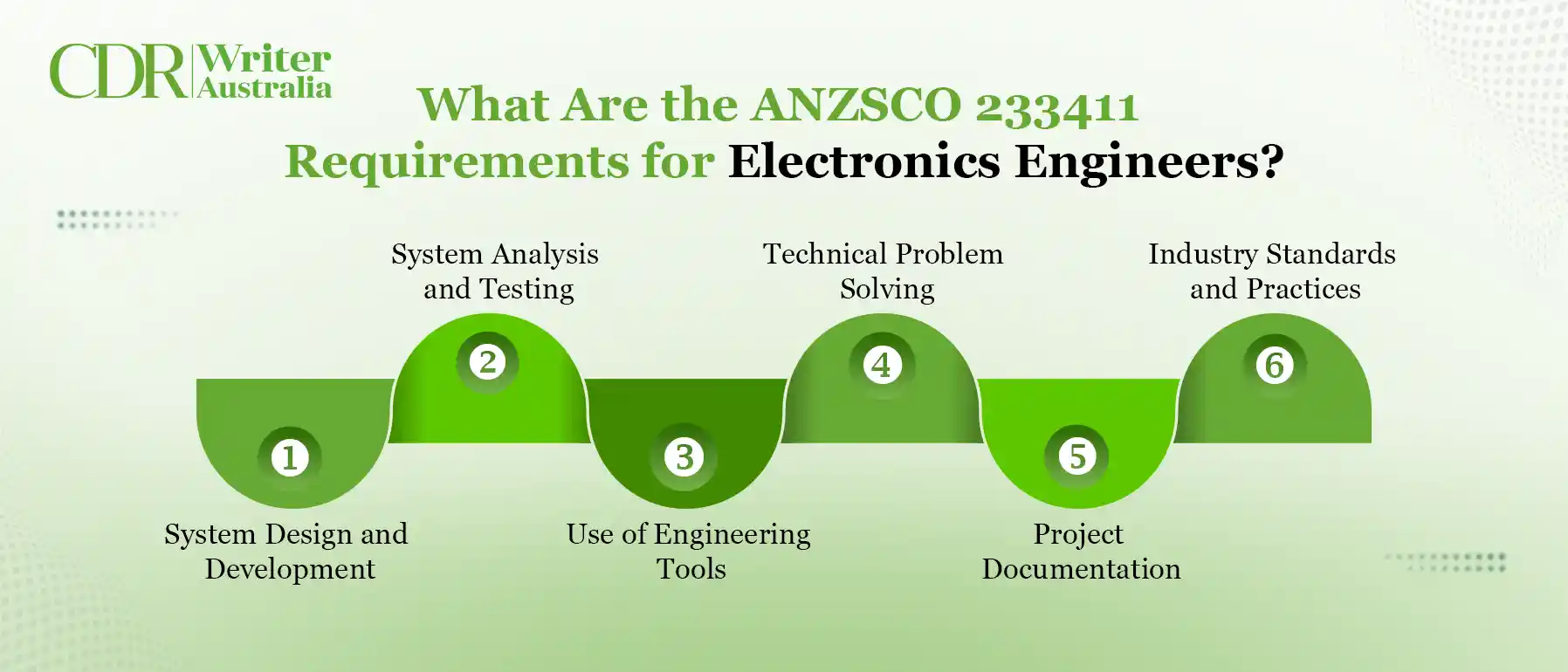
Electronics engineers under ANZSCO 233411 work on tasks such as designing systems, analysing performance, solving technical problems, and using engineering tools. The role also includes preparing technical documents and working with systems like communication and embedded technologies.
- System Design and Development: Designing, developing, and testing electronic systems such as communication equipment, control systems, and embedded devices forms a core part of the role.
- System Analysis and Testing: Analysing system performance, identifying technical issues, and applying solutions using engineering principles ensures systems operate efficiently.
- Use of Engineering Tools: Working with tools such as circuit design software, simulation platforms, and modeling techniques supports accurate design and system improvement.
- Technical Problem Solving: Identifying technical challenges and applying suitable solutions requires a strong understanding of electronics engineering concepts and practical application.
- Project Documentation: Preparing clear reports, technical specifications, and system documentation helps present engineering work in a structured and understandable way.
- Industry Standards and Practices: Following safety guidelines, industry standards, and best practices ensures reliable and compliant engineering outcomes.
What Are the Key Writing Guidelines for a CDR Report for Electronics Engineers?
Electronics engineers need to follow clear guidelines when preparing a CDR report, including selecting relevant projects, structuring career episodes, and mapping work to required competency elements.
- Career Episodes: Present three projects that involve real electronics work, such as PCB design, embedded system development, or communication system analysis, and clearly explain what tasks were handled.
- Summary Statement: Map each project task to the required competency elements and show how the work meets the standards expected for electronics engineers.
- Continuing Professional Development (CPD):List specific training, certifications, or courses that relate to electronics engineering tools, systems, or technologies.
- Curriculum Vitae (CV): Organize education and work experience by highlighting roles that involve electronics design, testing, or system development.
- Technical Explanation: Describe how each task was completed by mentioning the tools used, such as MATLAB, simulation software, or circuit design tools, along with methods and outcomes.
- Personal Contribution: Show individual involvement by clearly stating what actions were taken, what problems were solved, and what decisions were made during each project.
What Are the Common Mistakes in a CDR Report for Electronics Engineers?
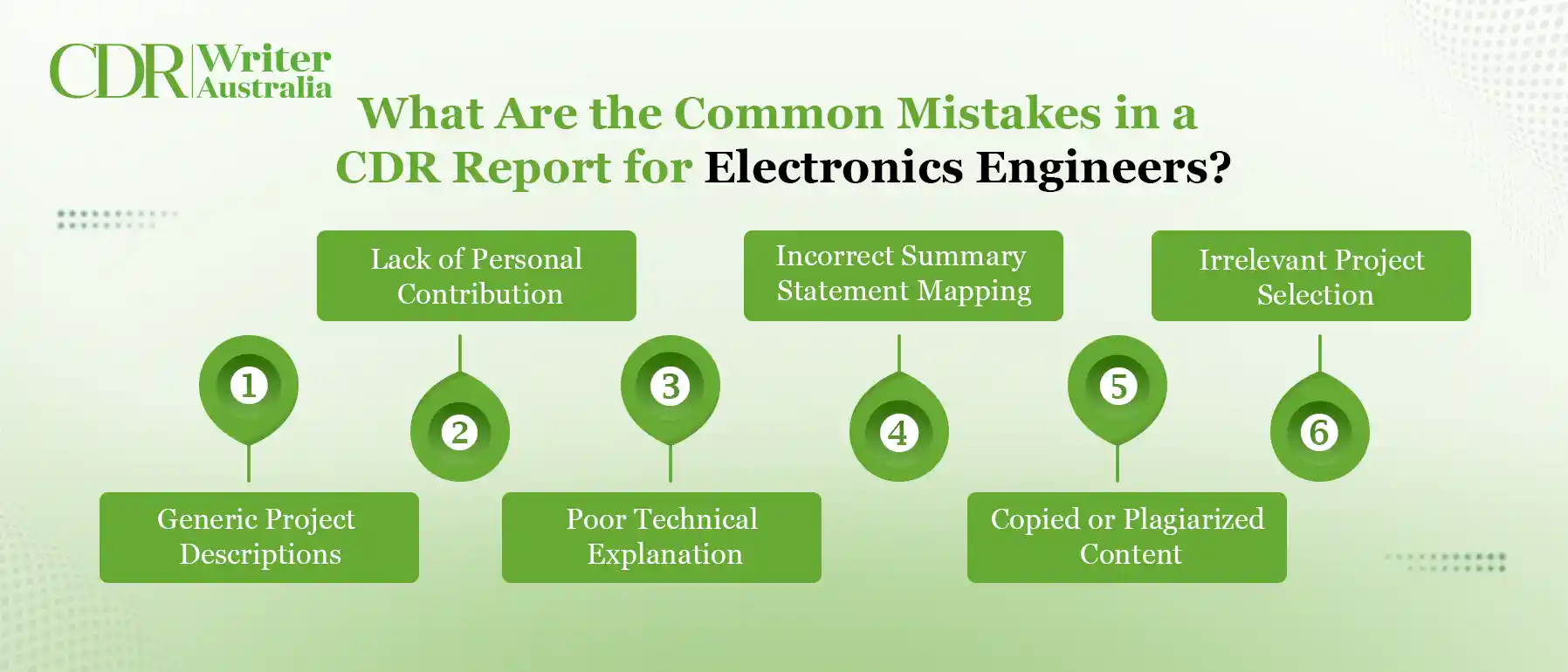
Electronics engineers often make mistakes in a CDR report when project details do not clearly explain tasks and individual roles. Missing technical explanations and incorrect competency mapping can reduce the chances of meeting ANZSCO 233411 requirements.
- Generic Project Descriptions: Writing project details without clearly explaining tasks performed, tools used, and results achieved in each electronics engineering project.
- Lack of Personal Contribution: Failing to state individual roles and responsibilities, which makes it unclear who handled specific tasks in the project.
- Poor Technical Explanation: Leaving out details about methods followed, tools applied, and engineering decisions made during project execution.
- Incorrect Summary Statement Mapping: Not linking project tasks to the required competency elements, which makes the assessment process difficult.
- Copied or Plagiarized Content: Using content from external sources instead of writing original project explanations, which leads to rejection during assessment.
- Irrelevant Project Selection:Including projects that do not involve electronics engineering tasks such as circuit design, embedded systems, or communication systems.
Also Read: Prevent CDR Rejection for the Second Time
Key Takeaways
Table of Content
Frequently Asked Questions
A CDR report for electronics engineers requires three career episodes, each based on a different project that shows individual roles, technical tasks, and engineering decisions.
Each career episode should stay within 1,000 to 2,500 words, with enough detail to explain project work, technical steps, and individual contributions clearly.
Electronics engineers can use academic projects, especially for entry-level profiles, as long as each project clearly explains technical work, tools used, and problem-solving steps.
Electronics engineers should mention tools such as MATLAB, circuit design software, simulation tools, or embedded system platforms used during project work.
Electronics engineers map competencies by linking specific tasks from career episodes to required competency elements with clear references to project sections.