
CDR for Engineers Australia: A Complete Guide
10 minute read
Publish date: 2026/03/23
Planning to apply for a skills assessment with Engineers Australia?
You might have heard about the Competency Demonstration Report (CDR), a report that helps international engineers demonstrate their engineering knowledge, qualifications, and professional experience.
So exactly, how crucial is CDR for skilled migration assessment to Australia?
This guide explains what a CDR for Engineers Australia is, its key components, how to prepare the report, and its possible outcomes.
What is the CDR Report for Engineers Australia?
A Competency Demonstration Report (CDR) is a technical document submitted by international engineers to Engineers Australia (EA) for skill assessment. The report provides a detailed account of an engineer’s professional competencies and practical experience.
In other words, a CDR acts as a pathway for engineers with non-accredited qualifications to obtain a positive skills assessment and pursue skilled migration to Australia. EA uses the CDR report to evaluate whether an applicant’s engineering knowledge, qualifications, and work experience meet Australian standards.
Who Needs to Submit a CDR for Engineers Australia?
Engineers with Non-Accredited Qualifications
Engineers whose degrees are not recognised under international accreditation agreements such as the Washington Accord, Sydney Accord, or Dublin Accord must submit a CDR report to EA. Then the assessors assess whether the applicant’s engineering knowledge and experience meet Australian standards.
Engineers Applying for Skilled Migration
Applicants seeking Australian skilled migration may need to submit a CDR during the Engineers Australia skills assessment process. Skills assessment assessors review the report to determine whether the applicant meets the competency requirements for the nominated engineering occupation.
Common skilled migration visas that may require an Engineers Australia skills assessment include:
- Subclass 189: Skilled Independent visa
- Subclass 190: Skilled Independent visa
- Subclass 491: Skilled Work Regional (Provisional) visa
What are the Components of CDR?

The CDR / CDR format includes CPD, three Career Episodes, and a Summary Statement.
- Continuing Professional Development (CPD)
- Career Episodes
- Summary Statement
Continuing Professional Development (CPD) lists the activities you completed to maintain and improve your engineering knowledge and skills. These activities may include workshops, training programs, seminars, technical courses, or conferences related to a specific engineering field. Applicants must present CPD in a chronological list that shows the title, date, duration, and location of each activity.
Career Episodes describe specific engineering tasks or projects you completed during your academic studies or professional career. EA requires three career episodes, each focusing on your personal engineering role, technical responsibilities, and problem-solving approach. These episodes demonstrate how you applied engineering knowledge and skills in practical situations.
The Summary Statement links the competency elements required by Engineers Australia to the relevant sections of your career episodes. In this section, you must indicate where each competency is demonstrated by referencing specific paragraphs from the episodes. The format of the Summary Statement depends on the nominated occupational category, such as Professional Engineer, Engineering Technologist, or Engineering Associate.
| CDR Component | Purpose |
|---|---|
| CPD (Continuing Professional Development) |
Demonstrates ongoing development of engineering knowledge and professional skills. |
| Career Episodes |
Demonstrates engineering competencies through practical engineering work and technical problem-solving. |
| Summary Statement |
Shows how the required competency elements are demonstrated in the career episodes. |
How to prepare a CDR report for Engineers Australia?
To prepare an enhanced CDR first review the Engineers Australia Migration Skills Assessment (MSA) guidelines to understand the required format and competency standards. Then organise relevant engineering education, projects, and professional experience and present them according to the required CDR structure.
When writing a CDR without professional assistance, the following steps help ensure the report meets Engineers Australia standards:
Begin by studying the Engineers Australia MSA booklet which outlines the structure, competency standards, and documentation requirements for the CDR.
Select relevant academic or professional engineering projects that clearly demonstrate engineering knowledge, technical responsibilities, and problem-solving ability.
Develop the Continuing Professional Development (CPD), three Career Episodes, and the Summary Statement according to Engineers Australia’s required format and competency framework.
Ensure the report contains original technical explanations of engineering activities. Engineers Australia uses plagiarism detection tools to verify authenticity.
Carefully review the report for technical clarity, structure, grammar, and alignment with the competency standards before submission.
What Can Be the Possible Results of CDR Report Evaluation?
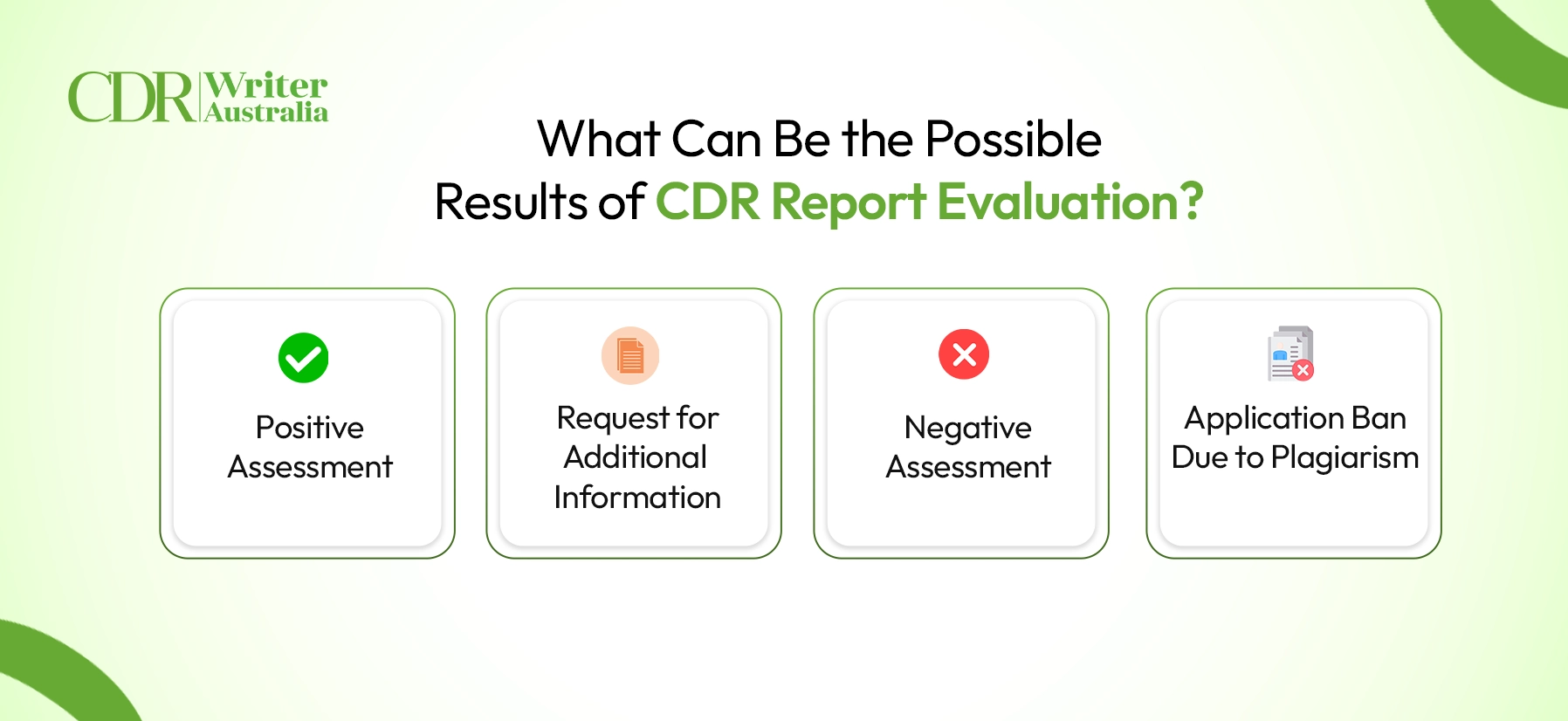
After submitting the CDR and required documents through the Engineers Australia portal an assessor reviews the report as part of the MSA process. Based on the assessment, EA issues one of the following outcomes:
1. Positive Assessment
EA issues a positive assessment when the report clearly demonstrates the required competency elements for the nominated engineering occupation. This result allows the applicant to use the assessment for skilled migration purposes.
2. Request for Additional Information
The assessor may request clarification or supporting documents if certain engineering activities or competency elements are not clearly explained in the report.
3. Negative Assessment
EA issues a negative assessment when the report does not demonstrate the required competencies or fails to meet the standards defined in the MSA guidelines.
4. Application Ban Due to Plagiarism
EA may reject the application and impose a reapplication ban if the assessor detects plagiarism, copied content, or fabricated information in the CDR.
Key Takeaways
Frequently Asked Questions
No, Engineers whose qualifications are accredited under agreements such as the Washington Accord, Sydney Accord, or Dublin Accord usually follow a different assessment pathway. Engineers with non-accredited qualifications must submit a CDR for skills assessment.
Engineers Australia accepts no plagiarism in a CDR. The report must contain original content that explains the applicant’s own engineering work and experience.
To make a top-notch CDR, follow the Engineers Australia MSA guidelines and prepare the report in the required structure with CPD, three Career Episodes, and a Summary Statement. Clearly explain engineering tasks, technical decisions, and project responsibilities using original content based on actual engineering work.
Yes, after Stage 1 CDR assessment, engineers can apply for Stage 2 assessment to obtain Chartered Engineer status with EA.
What did you think of the article? Anything you agree or disagree with? We would love to hear your thoughts.
Lets Chat


