
Employer Nomination Scheme 186 Visa for Skilled Workers in Australia
12 minute read
Publish date: 2026/05/06
Many Subclass 186 visa applicants face delays when the selected stream does not match their visa status, work history, or employer arrangement. Missing proof of employment dates, nominated occupation, skills assessment, English level, health checks, character records, or employer nomination can also delay the application.
Before applying, applicants should confirm the correct 186 visa stream and prepare evidence that matches the chosen pathway. This helps keep the nomination, visa application, and supporting documents aligned from the start.
In this guide, you will learn about the Subclass 186 visa streams, eligibility rules, required documents, application stages, costs, processing time, refusal reasons, and benefits after approval.
What Is the Employer Nomination Scheme Subclass 186 Visa?
The Employer Nomination Scheme Subclass 186 visa is a permanent visa for skilled workers nominated by an Australian employer. It helps an employer sponsor a worker for a genuinely skilled role in Australia. The worker can then apply for permanent residency by meeting the required visa conditions.
This visa suits skilled workers who already have an Australian employer willing to nominate them. The applicant may apply from inside or outside Australia, depending on their stream and situation. Home Affairs lists the 186 visa as an employer-sponsored permanent work visa for skilled migrants.
What Are the Subclass 186 Visa Streams?
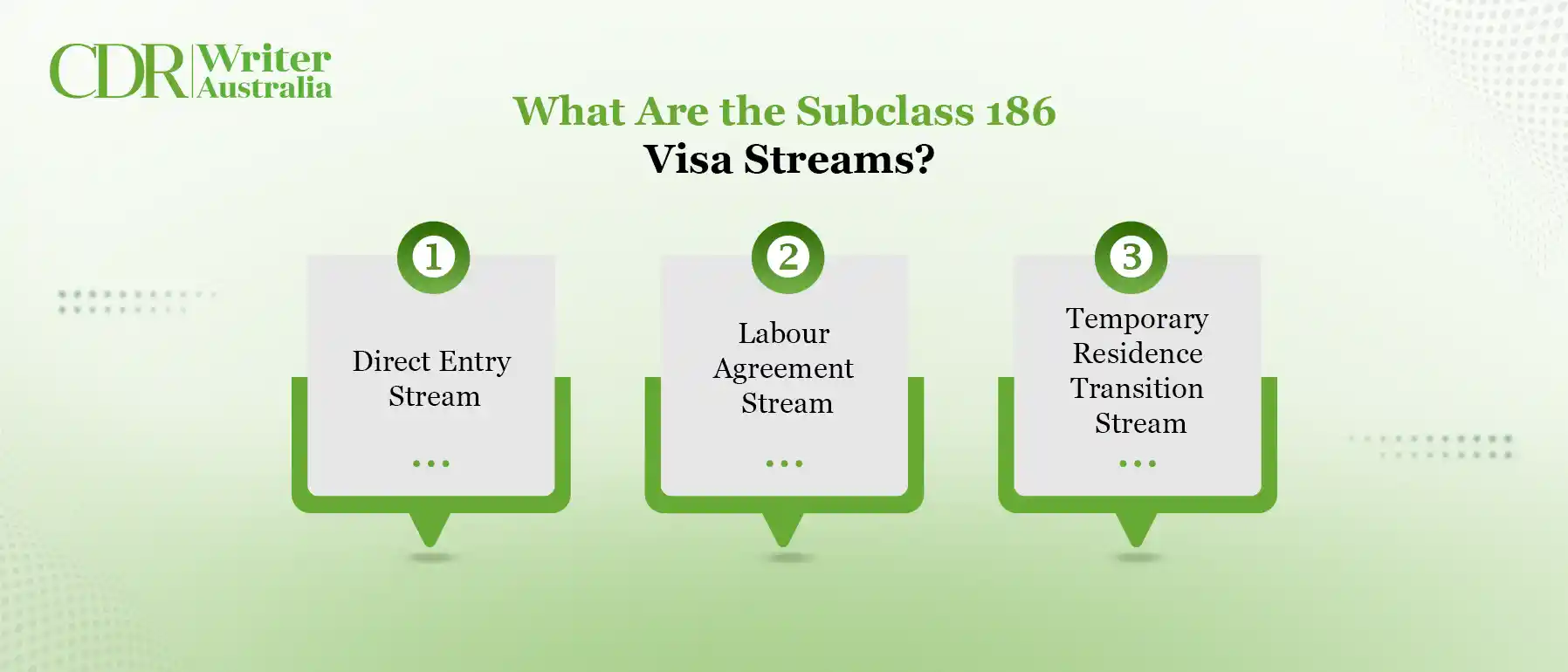
The Subclass 186 visa has three streams: Direct Entry, Labour Agreement, and Temporary Residence Transition. Each stream can lead to permanent residency, but the best fit depends on the worker’s current visa, job role, work history, and employer setup.
1. Direct Entry Stream
The Direct Entry stream allows an Australian employer to nominate a skilled worker for an eligible occupation. This stream often suits applicants who are applying from outside Australia or who do not qualify through the Temporary Residence Transition stream. The applicant must meet the occupation, skills, English, age, and nomination requirements for the role.
Stay: Permanently
Cost: From AUD 4,910
2. Labour Agreement Stream
The Labour Agreement stream allows an employer to nominate a skilled worker under a labour agreement with the Australian Government. This stream applies when the employer has approval to sponsor workers for specific roles, industries, or workforce needs under that agreement. The applicant must meet the conditions listed in the labour agreement.
Stay: Permanently
Cost: From AUD 4,910
3. Temporary Residence Transition Stream
The Temporary Residence Transition stream allows a current employer to nominate a worker already holding a subclass 457, subclass 482, or eligible bridging visa. In most cases, the worker must have completed at least two years of full-time eligible sponsored employment with the employer. This stream helps temporarily skilled workers move to permanent residency with the same sponsoring employer.
Stay: Permanently
Cost: From AUD 4,910
Note: Processing times vary by application. Check the official visa processing time guide for the latest estimate, as it shows recently decided applications only.
What Are the Eligibility Requirements for a 186 Visa?
A Subclass 186 visa works best when the nominated role clearly matches the worker’s occupation, skills, experience, English level, health, character, and ANZSCO code. A valid employer nomination is also required, and the worker must meet the rules of the selected visa stream.
1. Employer nomination:
An Australian employer must nominate the worker for a real skilled position. The role should match the business need, the worker’s occupation, and the selected 186 visa stream.
2. Age requirement:
Most workers must be under 45 when they apply. Some workers may qualify for an age exemption based on the stream, occupation, salary level, or visa conditions.
3. Skills and experience:
The worker must prove they can perform the nominated role. Direct Entry applicants usually need a positive skills assessment from the correct assessing authority.
4. English requirement:
The worker must meet the English level required by the selected stream. Most applicants prove English ability through an approved test, unless an exemption applies.
5. Health and character:
The worker must meet Australia’s health and character rules. This usually means completing medical checks and providing police certificates.
6. Occupation requirement:
The nominated role must match the correct ANZSCO code and stream rules. Direct Entry usually requires an occupation from the relevant skilled occupation list.
7. Skills assessment:
Direct Entry requires a positive skills assessment from the relevant assessing authority. Temporary Residence Transition usually does not require a new skills assessment.
How Does the Subclass 186 Visa Application Process Work?
The Subclass 186 visa process starts with the right stream and a matching employer nomination. The worker then submits evidence for skills, work history, English, health, and character. Home Affairs reviews both applications before giving the final decision.
Select the stream that matches the worker’s visa status, work history, and employer arrangement. Choose between Direct Entry, Temporary Residence Transition, or Labour Agreement.
Ask the employer to prepare the nomination for a genuine skilled role. Include job title, duties, salary, employment terms, and business need.
Prepare documents that prove identity, occupation, skills, work experience, English level, health, character, and family details if needed. Add a skills assessment when required.
Submit the employer nomination to Home Affairs. Make sure the nominated role, ANZSCO code, and employment details match the visa application.
Submit the Subclass 186 visa application under the same stream. Check that job details, occupation, dates, and documents match the nomination.
Complete medical tests and provide police certificates when requested. These checks confirm that the worker meets visa requirements.
Track the application and respond to any requests from Home Affairs. Once approved, the worker receives the Subclass 186 visa grant.
What Can You Do After a Subclass 186 Visa Is Granted?
Once the Subclass 186 visa is granted, the worker becomes an Australian permanent resident. Applicants can live in Australia permanently, work, study, access Medicare if eligible, travel for 5 years, sponsor eligible family members, and apply for citizenship after meeting the rules.
| Benefit | What It Means |
|---|---|
| Live in Australia permanently | Stay in Australia without depending on a temporary work visa. |
| Work in Australia | Continue working for the nominated employer and build a long-term career in Australia. |
| Study in Australia | Enrol in Australian courses, training programs, or higher education. |
| Access Medicare | Use Australia’s public healthcare system after meeting Medicare enrolment rules. |
| Sponsor family members | Sponsor eligible family members if the sponsorship rules are met. |
| Travel for 5 years | Leave and re-enter Australia during the 5-year travel facility period. |
| Apply for citizenship later | Apply for Australian citizenship after meeting residence and eligibility requirements. |
Key Takeaways
Frequently Asked Questions
Yes, the Subclass 186 visa gives permanent residency to skilled workers nominated by an Australian employer. After approval, the worker can live, work, and study in Australia permanently.
Yes, applicants can apply from inside or outside Australia, depending on the selected stream. Direct Entry often suits offshore applicants, while TRT usually suits workers already employed by their sponsoring employer in Australia.
No, every 186 visa applicant does not need a skills assessment. Direct Entry usually requires a positive skills assessment, while Temporary Residence Transition usually does not require a new one.
Subclass 186 visa holders can travel in and out of Australia for 5 years from the visa grant date. After that period, they need a Resident Return Visa to re-enter Australia as permanent residents.
Yes, applicants can include eligible family members in the 186 visa application. Family members must provide required identity documents and meet health and character requirements.