
Why NER Registration Matters for Engineers in Australia
7 minute read
Publish date: 2026/05/12
If you are preparing for National Engineering Register (NER) registration, the real question is whether the assessment, documents, and fees will support your engineering career. Many engineers apply because they want verified recognition, stronger client trust, and clearer proof of independent practice.
NER registration can offer more than just passing the assessment. It helps engineers build credibility, gain public recognition, use the NER post-nominal, and support future registration pathways.
In this blog, we explain the main benefits of becoming a NER registered engineer and how registration can support long-term career growth.
Who Should Consider NER Registration?
NER registration may be worth considering when an engineer wants their experience and practice area formally recognised. It can also support career moves into client-facing roles, regulated projects, or state registration pathways.
1. Engineers working in regulated roles: Engineers in civil, structural, electrical, mechanical, or fire safety roles may need registration for certain projects or states.
2. Experienced engineers with recent work history: Engineers can use NER to show that their recent industry experience meets recognised professional standards.
3. EA members and non-members: Both EA members and non-members can apply if they meet the NER assessment requirements.
4. Engineers working with clients or contractors: Engineers who give technical advice, manage projects, or work with external clients can use NER to build trust.
5. Engineers planning state registration: Engineers can use NER as a supporting credential when applying for state registration later.
Also read: NER Assessment: A Simple Explanation
Key Benefits of Being a NER Registered Engineer
NER registration helps engineers build professional credibility, show verified competency, and strengthen trust with employers, clients, and industry bodies. It also gives public recognition for the engineer’s experience and area of practice.
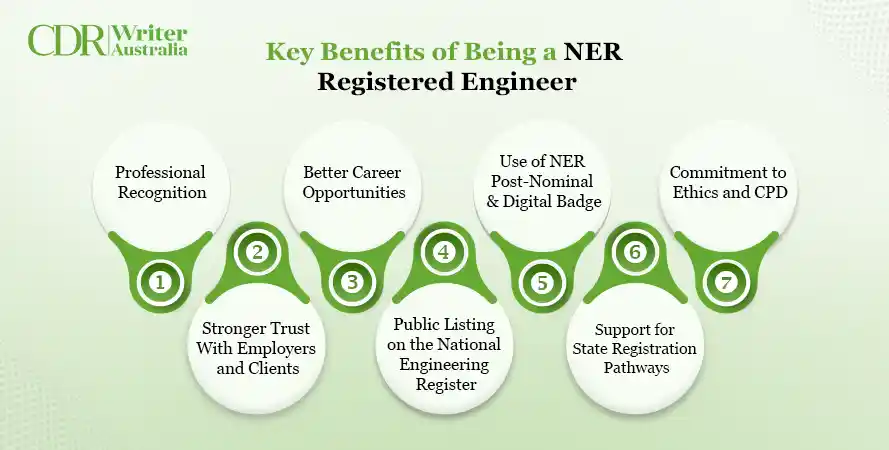
1. Professional Recognition
NER registration confirms that Engineers Australia has reviewed the engineer’s experience, competency, and area of practice. This gives engineers a stronger way to prove professional capability beyond a resume or job title.
2. Stronger Trust With Employers and Clients
Employers and clients can search the National Engineering Register to check the engineer’s registration status and area of practice. This gives them clearer proof before hiring, assigning project work, or accepting technical advice.
3. Better Career Opportunities
NER registration helps engineers stand out for senior roles, consulting work, and projects that require verified engineering credentials. It shows employers and clients that the engineer can work independently in a recognised area of practice.
4. Public Listing on the National Engineering Register
The National Engineering Register displays the engineer’s registration status and area of practice. This helps clients, employers, and industry bodies confirm the engineer’s professional status before making work-related decisions.
5. Use of NER Post-Nominal and Digital Badge
Registered engineers can add the NER post-nominal and digital badge to LinkedIn, resumes, email signatures, and project proposals. This helps employers and clients recognise the credential quickly in professional communication.
6. Support for State Registration Pathways
NER registration can help engineers support state registration applications when they need recognised proof of competency. This matters for engineers working in regulated areas or planning to practise in states with registration requirements.
7. Commitment to Ethics and CPD
NER registration shows that the engineer follows professional standards and continues learning through CPD. This helps employers, clients, and project stakeholders trust the engineer’s current skills and professional conduct.
Also read: 7 Common Challenges in NER Applications
How is a NER Registered Engineer Different From a Non-Registered Engineer?
The main difference is proof. A NER-registered engineer can show verified competency through the National Engineering Register, while a non-registered engineer usually depends on resumes, references, and project records to prove experience.
| Factor | NER Registered Engineer | Non-Registered Engineer |
|---|---|---|
| Public Verification | Appears on the National Engineering Register | Does not appear on the NER |
| Professional Recognition | Shows EA-reviewed competency and practice area | Relies on qualifications and work history |
| Client Trust | Gives clients a quick way to check registration status | May need extra evidence to prove capability |
| Post-Nominal Use | Can use the NER post-nominal | Cannot use the NER post-nominal |
| State Registration Support | Can support state registration applications | May need separate competency evidence |
Key Takeaways
Frequently Asked Questions
Yes, NER registration is worth it for engineers who want employers and clients to verify their competency through a public register.
Yes, NER registration can support state registration because it gives recognised evidence of the engineer’s assessed competency and practice area.
Yes, clients can search the National Engineering Register and check the engineer’s registration status before assigning work.
Yes, NER registered engineers can use a digital badge on LinkedIn, resumes, email signatures, and project proposals.


