
How to Apply for Skilled Migration as a Civil Engineer?
In the process of migrating to Australia, many civil engineers face challenges with skills assessment, points requirements, and visa selection. Even small errors or missing requirements can slow down the application or reduce your chances of getting visa approval.
Start by checking if you meet the eligibility criteria and complete your skills assessment with accurate and complete details. Then calculate your points carefully and choose a visa option that aligns with your qualifications and overall profile.
In this guide, you’ll learn how to apply for skilled migration as a civil engineer, including eligibility criteria, skills assessment, and visa options.
Overview of Skilled Migration for Civil Engineers in Australia
Civil engineers can apply for skilled migration to Australia through a process that checks their qualifications and work experience. Engineers Australia carries out the Migration Skills Assessment (MSA) to confirm that your background matches civil engineering roles in Australia.
Civil engineering falls under ANZSCO 233211, which authorities use to identify your occupation during the migration process. This code also helps them match your job role with the correct occupation, assess your eligibility, and process your application under the right visa category.
What Are the Eligibility Criteria for Civil Engineer Migration to Australia?
Civil engineer migration to Australia requires a recognised engineering degree, relevant work experience, and a valid English test score. It also uses a points-based assessment based on factors such as age, education, and work experience.
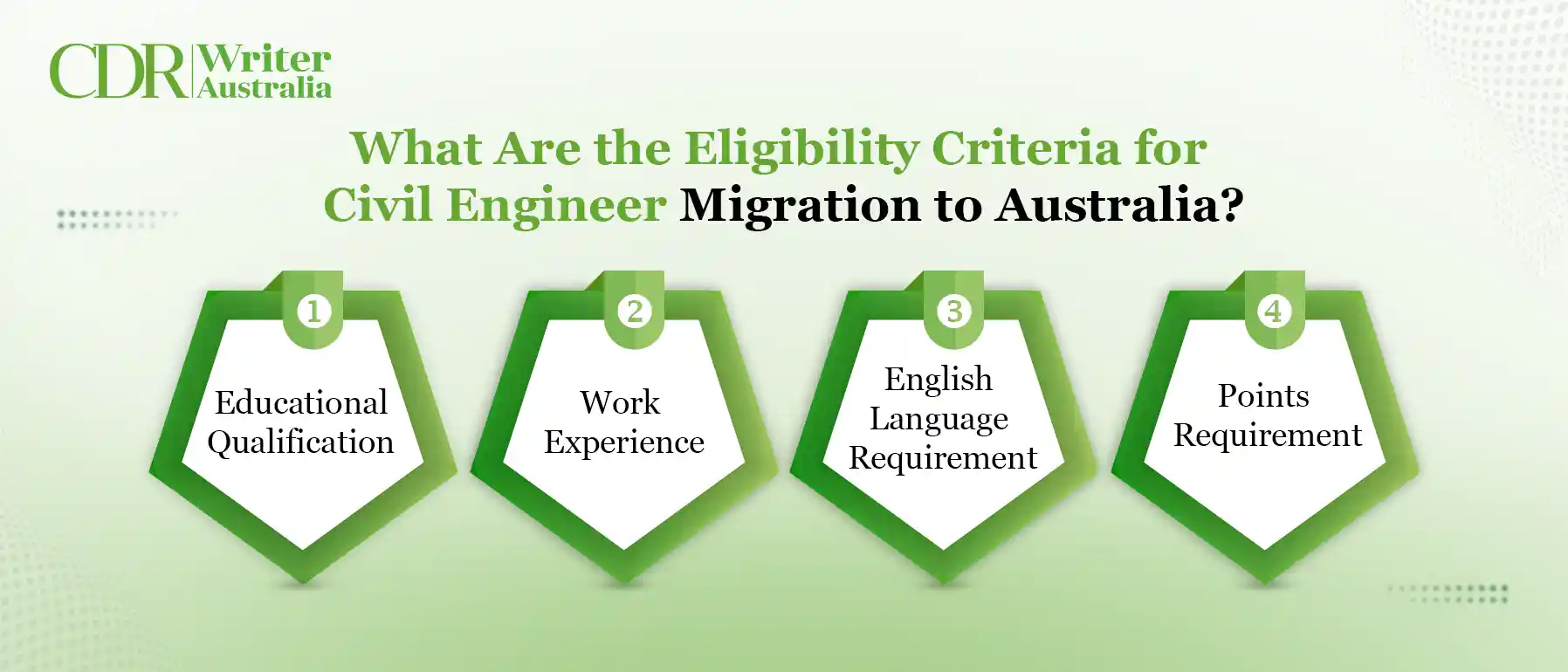
- Educational Qualification: A Bachelor’s degree in Civil Engineering or a closely related field is required. The qualification should be comparable to an Australian Bachelor’s degree and must cover core civil engineering subjects such as structural design, geotechnics, and construction.
- Work Experience: Relevant work experience in civil engineering strengthens the application. At least 1–3 years of experience in roles involving design, planning, or project execution is generally expected for better recognition during assessment.
- English Language Requirement: Proof of English proficiency is required through an approved test. Engineers Australia accepts the following minimum scores:
- Points Requirement: A minimum of 65 points is required to apply for skilled migration in Australia. The points system evaluates age, education, work experience, and English test results.
| Test | Listening | Reading | Writing | Speaking |
|---|---|---|---|---|
| IELTS Academic | 6 | 6 | 6 | 6 |
| TOEFL iBT | 12 | 13 | 21 | 18 |
| PTE Academic | 50 | 50 | 50 | 50 |
What is the Skills Assessment for Civil Engineers in Australia?
The skills assessment acts as a screening stage in the migration process for civil engineers. It confirms whether a profile meets the required level for civil engineering roles before moving ahead with a visa application.
Civil engineers can complete the skills assessment through the following pathways, depending on how their qualifications are recognised.
- Accredited Qualification Pathway: This pathway applies when the engineering degree comes from a university whose program aligns with the standards set by Engineers Australia. Generally, recognition is based on agreements such as:
- Washington Accord
- Sydney Accord
- Dublin Accord
- Non-Accredited Qualification (CDR) Pathway: This pathway applies when the qualification does not align with EA standards. In this case, a CDR is required to show that the knowledge and skills meet the expected level for civil engineering roles in Australia through detailed project reports and work examples.
In this case, the applicant still needs to apply for a skills assessment, but does not need to submit a CDR because the qualification already meets the accepted standards.
How to Apply for Skilled Migration as a Civil Engineer?
Applying for skilled migration as a civil engineer follows a step-by-step process that starts with skills assessment, then moves through eligibility checks, application submission, and ends with a visa decision.
Start by applying for a MSA through Engineers Australia. This step verifies that the qualifications and work experience match civil engineering standards in Australia. You will be required to provide the following documents:
- Degree certificate
- Academic transcripts
- CV
- Employment reference letters (with roles and responsibilities)
- Project reports (for CDR pathway)
- CPD (Continuing Professional Development) list
Complete an approved English test such as IELTS, TOEFL, or PTE to meet visa requirements. In some cases, the test may also be needed during the skills assessment stage.
Check the total points based on age, education, work experience, and English test results. A minimum of 65 points is required to apply, but higher scores improve the chances of receiving an invitation.
Go to the Australian Government’s SkillSelect website and create an Expression of Interest (EOI). Fill out the details about passport information, skills assessment, English test scores, education, and work experience.
Wait for an invitation based on the points score and occupation demand. Only profiles with competitive points are selected and invited to apply for the visa.
Apply for the visa after receiving the invitation. This step requires uploading the following documents for final verification:
- Identity documents (passport)
- Skills assessment result
- English test results
- Work experience proof
- Education documents
Complete the required medical tests with an approved doctor and obtain police clearance certificates to show good health and a clean background.
Wait for the visa decision after completing all the steps. Once approved, the visa lets you move to Australia and work as a civil engineer.
Which Visa Options are Available for Civil Engineers Migrating to Australia?
Australia offers the following skilled visa options for civil engineers, based on eligibility, points score, and whether state or regional approval is involved.
- Subclass 189 Skilled Independent Visa: No state or employer sponsorship is needed for the subclass 189 visa. Permanent residency is granted, allowing work on civil engineering and infrastructure projects anywhere in Australia.
- Subclass 190 Skilled Nominated Visa: Australian states or territories approve the subclass 190 visa for applicants based on the demand for civil engineers in a specific area.
- Subclass 491 Skilled Work Regional Visa: Australian states, territories, or eligible family members in regional areas approve subclass 491 visa based on the demand for civil engineers in those locations.
Key Takeaways
Table of Content
- How to skill migrate to Australia as a Civil engineer?
- Migrate To Australia As A Civil Engineer
- Brief Summary of Civil Engineering
- Tasks as a Civil Engineer
- Visa Options for Civil Engineers to Migrate Australia
- Civil Engineer Skill Assessment (ANZSCO Code: 233211)
- Assessment Pathways For Australian Skills Migration
- Difference Between 189 and 190 Visa : Skilled Independent & Nominated Visa
Frequently Asked Questions
Yes, a skills assessment is a required part of the migration process. When applying through the CDR pathway, it involves preparing career episodes based on actual projects, writing a summary statement that maps skills to engineering competencies, and listing CPD activities to show ongoing learning.
A minimum of 65 points is required to apply. The points system adds scores based on age, education, work experience, and English test results, and higher totals improve the chances of receiving an invitation.
Yes, it is possible to apply with limited experience, especially with a strong academic background. However, including project-based work or internships helps demonstrate practical skills during the skills assessment.
The skills assessment process takes around 8 to 12 weeks, depending on the application type and document quality. Incomplete documents or unclear project details can delay the assessment.
A rejection usually means the submitted documents do not clearly demonstrate the required engineering competencies. Improving project reports, adding clearer work experience details, and resubmitting the application can help achieve a better outcome.