
Skilled Independent Visa Subclass 189
14 minute read
Publish date: 2026/05/01
Many skilled workers want to move to Australia permanently but struggle to secure employer sponsorship or state nomination. Changing points scores, invitation rounds, occupation lists, and visa rules often make the process harder to understand.
The Skilled Independent Visa Subclass 189 gives eligible skilled workers a direct permanent residency pathway through the points-tested migration system.
In this guide, you will learn who can apply for Subclass 189, how the points system works, current visa fees, processing time, and the step-by-step application process.
Overview of Skilled Independent Visa Subclass 189
The skilled independent visa subclass 189 grants permanent residency to invited skilled workers without requiring employer sponsorship, state nomination, or family sponsorship. Engineers, IT professionals, healthcare workers, tradespeople, and other in-demand professionals often apply for this visa to migrate independently.
Australia manages Subclass 189 through its points-tested migration system. Applicants usually need an eligible occupation, a positive skills assessment, a competitive points score, and an invitation to apply before lodging the visa application.
Once granted, visa holders can live and work anywhere in Australia permanently. The visa gives access to Medicare, allows eligible family members to be included in the application, and includes a five-year travel facility for overseas travel and return to Australia. It also opens a pathway to Australian citizenship after meeting the required residency conditions.
What Makes You Eligible for a Subclass 189 Visa?
Several clear requirements decide eligibility for Subclass 189 Visa under Australia’s skilled migration program. Applicants must meet the points-tested criteria and receive an invitation before lodging the visa application.
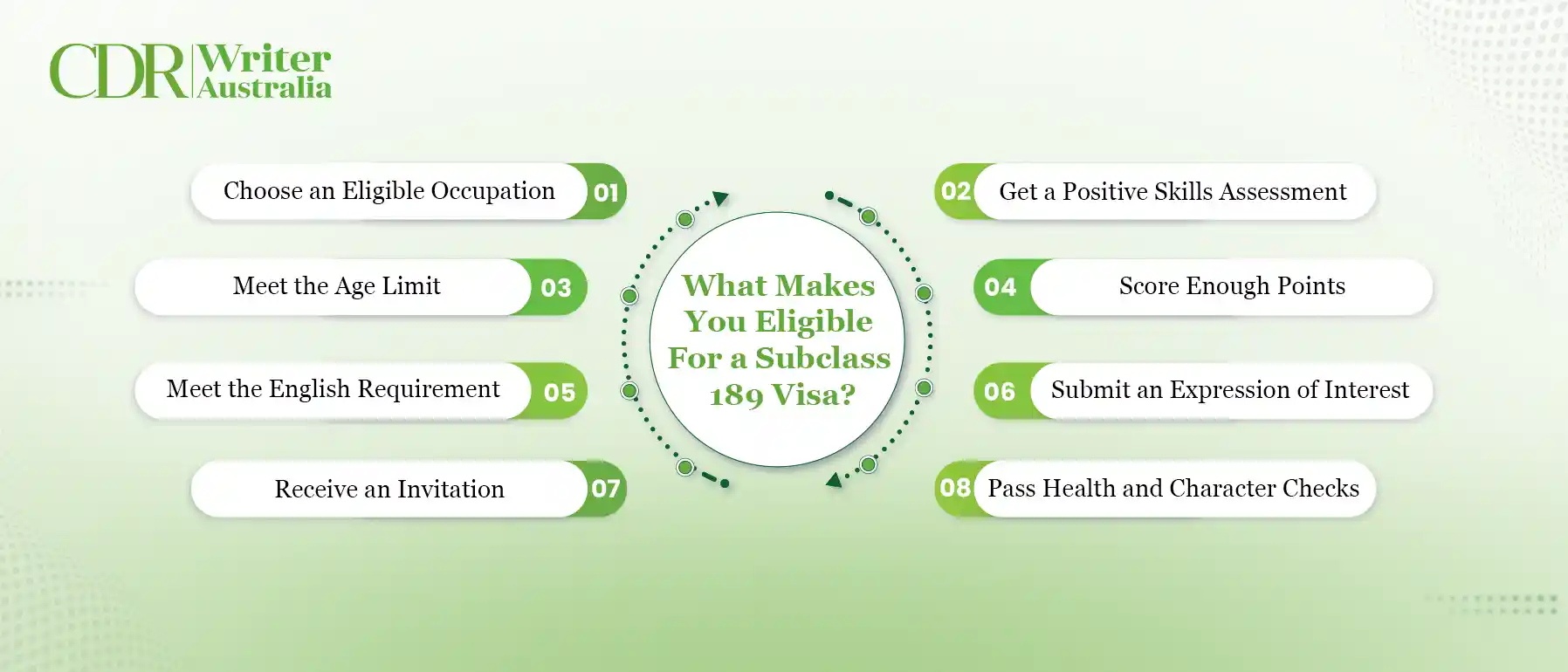
1. Choose an Eligible Occupation:
The nominated occupation must appear on the current skilled occupation list available for Subclass 189 invitations.
2. Get a Positive Skills Assessment:
The approved assessing authority must confirm that qualifications and work experience match the duties and standards of the nominated occupation.
3. Meet the Age Limit:
Applicants usually need to be under 45 years old on the date Australia sends the invitation to apply.
4. Score Enough Points:
A minimum of 65 points is required, but applicants with higher scores often receive invitations sooner.
5. Meet the English Requirement:
Applicants must prove English ability through accepted tests such as IELTS, PTE Academic, TOEFL iBT, or another approved option.
6. Submit an Expression of Interest:
An expression of interest (EOI) must be lodged through SkillSelect so Australia can review the profile in future invitation rounds.
7. Receive an Invitation:
The visa application can only be submitted after Australia issues an official invitation to apply.
8. Pass Health and Character Checks:
Applicants must complete medical examinations and provide police clearance certificates before Australia makes the final visa decision.
What Are the Current Subclass 189 Visa Streams?
Subclass 189 Visa currently has three recognised streams: Points-Tested Stream, Hong Kong Stream, and the former New Zealand Stream. Each stream grants permanent residency, but the eligibility rules depend on nationality, visa history, or the pathway used to apply.
1. Points-Tested Stream
The Points-Tested Stream is the main Subclass 189 pathway for skilled workers who qualify through Australia’s migration points system. Engineers, IT professionals, healthcare workers, accountants, tradespeople, and other skilled migrants commonly apply through this stream.
Stay: Permanent residency (PR)
Visa Application Charge: From AUD 4,910 for the main applicant. Additional applicant charges may apply for partners and dependent children.
This stream allows applicants to:
- live anywhere in Australia without state restrictions
- work for any employer or operate a business
- study at Australian universities, colleges, or training institutes
- include eligible family members in the application
- apply for Australian citizenship after meeting residency rules
Generally, point-based stream requirements include:
- nominate an occupation listed for Subclass 189 invitations
- obtain a positive skills assessment from the correct authority
- claim a competitive migration points score
- submit an Expression of Interest (EOI) through SkillSelect
- receive an invitation before lodging the visa application
2. Hong Kong Stream
The Hong Kong Stream provides a dedicated Subclass 189 pathway for eligible Hong Kong passport holders and British National (Overseas) passport holders. Applicants must complete the required period of residence in Australia while holding an eligible temporary visa.
Stay: Permanent residency (PR)
Visa Application Charge: From AUD 4,910 for the main applicant. Additional applicant charges may apply for partners and dependent children.
This stream allows applicants to:
- remain in Australia permanently after meeting stream conditions
- live, work, and study anywhere in Australia
- include eligible family members in the application
- apply for Australian citizenship when eligible
Usually, Hong Kong includes the following requirements:
- hold a Hong Kong passport or BN(O) passport
- hold an eligible temporary visa in Australia
- complete the required residence period in Australia
- meet health, character, and identity requirements
Note: Australia permanently closed the New Zealand Stream to new primary applications on 1 July 2023. The stream no longer accepts new Subclass 189 applicants.
How Does the Subclass 189 Points System Work?
Points are awarded based on age, English ability, skilled work experience, education, and other qualifying factors. Australia uses a points-tested system to rank Subclass 189 applicants before sending invitations
1. Age Points
| Age Range | Points |
|---|---|
| 18 to 24 years | 25 |
| 25 to 32 years | 30 |
| 33 to 39 years | 25 |
| 40 to 44 years | 15 |
2. English Language Points
| English Level | Points |
|---|---|
| Competent English | 0 |
| Proficient English | 10 |
| Superior English | 20 |
3. Overseas Skilled Work Experience Points
| Relevant Overseas Experience | Points |
|---|---|
| Less than 3 years | 0 |
| 3 to 5 years | 5 |
| 5 to 8 years | 10 |
| 8 years or more | 15 |
4. Australian Skilled Work Experience Points
| Relevant Australian Experience | Points |
|---|---|
| Less than 1 year | 0 |
| 1 to 2 years | 5 |
| 3 to 5 years | 10 |
| 5 to 8 years | 15 |
| 8 years or more | 20 |
5. Education Points
| Qualification | Points |
|---|---|
| Doctorate (PhD) | 20 |
| Bachelor’s Degree | 15 |
| Diploma or Trade Qualification | 10 |
| Relevant recognised qualification | 10 |
6. Extra Points
| Additional Factor | Points |
|---|---|
| Australian study requirement | 5 |
| Professional Year in Australia | 5 |
| Credentialled community language | 5 |
| Study in regional Australia | 5 |
7. Partner Points
| Partner Factor | Points |
|---|---|
| Skilled partner criteria met | 10 |
| Partner with competent English | 5 |
| Single applicant or partner is Australian citizen / PR | 10 |
Note: Applicants need at least 65 points to become eligible, but higher scores often improve invitation chances.
How to Apply for Subclass 189 Visa Step by Step?
Applying for Subclass 189 Visa for PR follows a clear process that starts with checking your points, occupation, and eligibility requirements. From there, the journey moves through skills assessment, EOI submission, invitation, document upload, and the final visa decision.
Step 1: Check your eligibility by confirming your occupation, age, English level, work experience, and migration points.
What Documents Do You Need for Subclass 189 Visa?
Subclass 189 applicants need documents that confirm identity, skills assessment, English results, education history, employment claims, and family details included in the application. Some applicants may also need extra records when personal circumstances or Home Affairs requests require them.
| Document Type | Common Documents |
|---|---|
| Identity | Passport, birth certificate, national ID card, passport-size photo |
| Skills Assessment | Positive skills assessment outcome letter, assessment reference details |
| English Language Proficiency | IELTS, PTE, TOEFL iBT, or other approved test result |
| Education | Degree certificate, diploma, trade qualification, academic transcripts |
| Employment | Reference letters, payslips, contracts, tax records, updated CV |
| Partner or Family | Marriage certificate, partner passport, children’s birth certificates |
| Character | Police clearance certificates |
| Health | Medical examination records when requested |
| Other Supporting Documents | Name change documents, additional forms, extra evidence requested by Home Affair |
Also Read: Complete Document Checklist for ACS Skill Assessment
Subclass 189 Visa vs 190 Visa: How Do They Differ?
Subclass 189 Visa and Subclass 190 Visa both help skilled workers secure permanent residency in Australia, but the application pathways are different. In simple terms, Subclass 189 suits applicants who qualify through their own points score, while Subclass 190 suits applicants who receive a nomination from a state or territory government.
| Feature | Subclass 189 Visa | Subclass 190 Visa |
|---|---|---|
| Visa Type | Grants permanent residency directly | Grants permanent residency directly |
| Sponsorship Need | Does not require employer, family, or state sponsorship | Requires nomination from an Australian state or territory |
| Invitation Pathway | Australia invites applicants through SkillSelect based on points | Applicants first secure state nomination, then receive an invitation |
| Points Requirement | At least 65 points | Requires at least 65 points before nomination benefits |
| Extra Points | Does not add nomination points | State nomination adds extra migration points |
| Occupation Access | Uses occupations open for Subclass 189 invitations | Depends on each state or territory's occupation list |
| Location Flexibility | Allows living and working anywhere in Australia | States often expect applicants to settle and work in the nominating region initially |
| Best Suited For | Applicants with strong points scores and independent eligibility | Applicants who need extra points or broader occupation options |
| Citizenship Pathway | Allows citizenship eligibility after meeting residency rules | Allows citizenship eligibility after meeting residency rules |
Key Takeaways
Frequently Asked Questions
Yes, Subclass 189 Visa can be refused if an applicant fails to meet age, points, skills assessment, health, or character requirements. Incorrect documents, false claims, or missing evidence can also cause refusal.
Subclass 189 Visa allows successful applicants to stay in Australia permanently. It gives indefinite residence rights and allows living, working, and studying anywhere in Australia.
Yes, applicants can bring eligible family members on Subclass 189 Visa. A spouse or partner and dependent children can usually be added to the application if they meet visa requirements.
Yes, Subclass 189 Visa can lead to Australian citizenship after applicants meet the residence period, character checks, and other citizenship conditions set by Australia.
Applicants usually need a Resident Return Visa (RRV) after the five-year travel facility ends. Permanent residency status remains, but re-entry rights may need renewal.