
Engineers Australia CPD Types and Chartered Requirements
9 minute read
Publish date: 2026/05/21
Engineers may complete Continuing Professional Development (CPD) activities throughout the year, but the record can still fall short if they track the wrong activity types. Problems often appear when the CPD record misses Engineers Australia’s hour limits, practice-area requirements, or Chartered conditions.
That is why choosing the right CPD type matters. Each activity should fit the correct category so engineers can count valid hours and meet Engineers Australia’s Chartered CPD requirements without confusion.
In this blog, we explain Engineers Australia CPD types, Chartered engineer CPD requirements, and CPD hour limits in simple terms.
What Are the Engineers Australia CPD Types and Conditions?
Engineers Australia CPD types include tertiary study, short courses, workplace learning, and private study. They also cover professional service, technical presentations, academic industry involvement, and other structured learning.
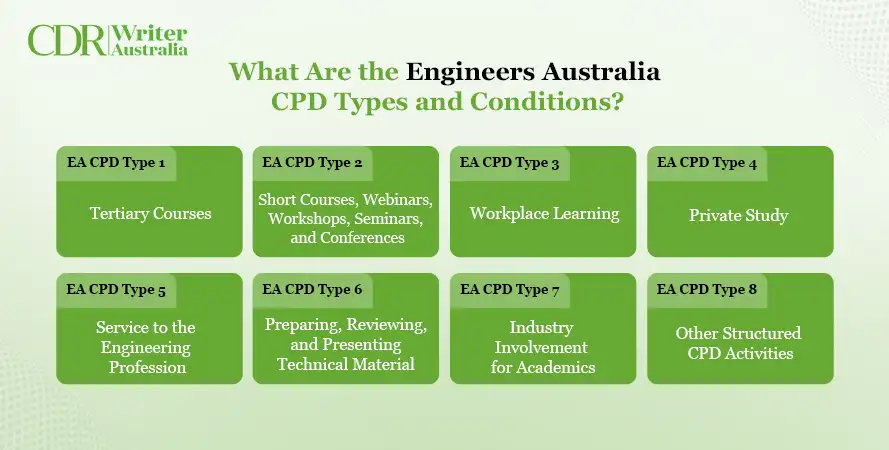
Engineers use tertiary courses when they complete formal study to improve their engineering knowledge or move into a specialised area. This CPD type suits engineers taking university subjects, individual course units, or postgraduate study related to their area of practice.
Condition: Engineers can claim unlimited hours for Type I CPD within any CPD period.
Note: Record the actual study hours from lectures, tutorials, laboratory sessions, assessments, or structured online classes.
Type II CPD covers structured learning delivered through short courses, webinars, workshops, seminars, conferences, and technical meetings. These activities help build technical knowledge, industry awareness, and professional practice through guided sessions.
Condition: There is no limitto the maximum number of hours that you can claim in any CPD period.
Note: Record the activity title, provider, date, duration, and evidence of attendance or completion.
Workplace learning counts as CPD when a job activity builds new engineering knowledge or improves professional practice. Regular duties alone do not count unless they involve a new method, tool, process, standard, or technical skill.
Condition: Type III CPD allows a maximum of 75 hours within any CPD period.
Note: Record what you learned, how you applied it at work, and how it improved your engineering practice.
Private study works well for engineers who build knowledge through self-paced learning. Reading technical books, standards, manuals, research papers, or engineering articles can count when the activity improves professional practice.
Condition: Type IV CPD allows a maximum of 75 hours within any CPD period.
Note: Record the title, author or source, reading date, and time spent so the private study hours can be verified during CPD review.
Service activities count when engineers contribute to the profession outside normal job duties. This may include mentoring, committee work, accreditation activities, technical reviews, or professional body involvement.
Condition: Type V CPD allows a maximum of 50 hours within any CPD period.
Note: Keep details of the organisation, your role, the professional contribution made, and the hours spent.
Technical material counts when engineers prepare, review, or present knowledge for professional learning. This may include conference papers, seminars, lectures, technical presentations, or published engineering content.
Condition: Type VI CPD allows up to 45 hours for each published paper, or up to 75 hours for critically peer-reviewed papers.
Note: Keep details of the presentation topic, publication or event name, review status, and preparation hours.
Industry involvement helps academic engineers stay connected with current engineering practice. Consulting work, industry research, fieldwork, secondments, and industry projects can support this CPD type.
Condition: Academic engineers should complete at least 40 hours of industry involvement within a CPD period.
Note: Keep evidence of the industry partner, activity type, project involvement, and completed hours to show real engagement with current engineering practice.
Other structured CPD covers planned learning that supports engineering knowledge but does not fit the earlier CPD types. The activity should have a clear learning purpose and a direct link to engineering practice.
Condition: Keep evidence that shows the activity is structured and relevant to professional development.
Note: Provide proof of the activity structure, learning goal, outcome achieved, and time spent to show why the activity fits Type VIII CPD.
Also Read: How to Write a CPD For Engineers Australia?
What Are the CPD Requirements for Chartered Engineers?
Chartered engineers need to complete 150 CPD hours every three years to keep their Chartered status active. These hours must cover practice-area learning, risk management, business skills, and other learning that supports their engineering career.
| CPD Requirement | Required Hours |
|---|---|
| Area of engineering practice | 50 hours |
| Risk management | 10 hours |
| Business and management skills | 15 hours |
| Remaining career-relevant CPD | 75 hours |
| Total CPD requirement | 150 hours |
Key Takeaways
Frequently Asked Questions
No, one CPD activity should only count under one CPD type. If engineers record the same activity twice, the CPD hours may look duplicated during review.
No, normal workplace duty does not count as CPD. It only counts when the task teaches a new skill, method, standard, or technical process.
Yes, engineers should keep evidence for every CPD activity. Without proof, reviewers may not verify the claimed hours.
Yes, online courses can count as Engineers Australia CPD. The course should relate to engineering practice, technical knowledge, or professional development.
Wrong CPD type selection can make the hours harder to verify because the evidence may not match the selected category. Engineers may need to reclassify the activity or provide extra proof during CPD review.

