
How to Write a CPD for Engineers Australia? (Step-by-Step Guide)
9 minute read
Publish date: 2026/03/31
Continuing Professional Development (CPD) plays a key role in your CDR application for Engineers Australia (EA), as it shows how you have developed your engineering knowledge and skills over time. Even small mistakes in your CPD can affect your assessment or lead to rejection.
A well-prepared CPD clearly lists your activities, shows how you have improved your skills, and follows the required format set by EA. This helps assessors understand your professional development and evaluate your application correctly.
In this guide, you will learn how to write a CPD step by step, including what to include, how to structure it, and how to present it clearly for a successful assessment.
Let’s dive in!
What to Include in a CPD for Engineers Australia?
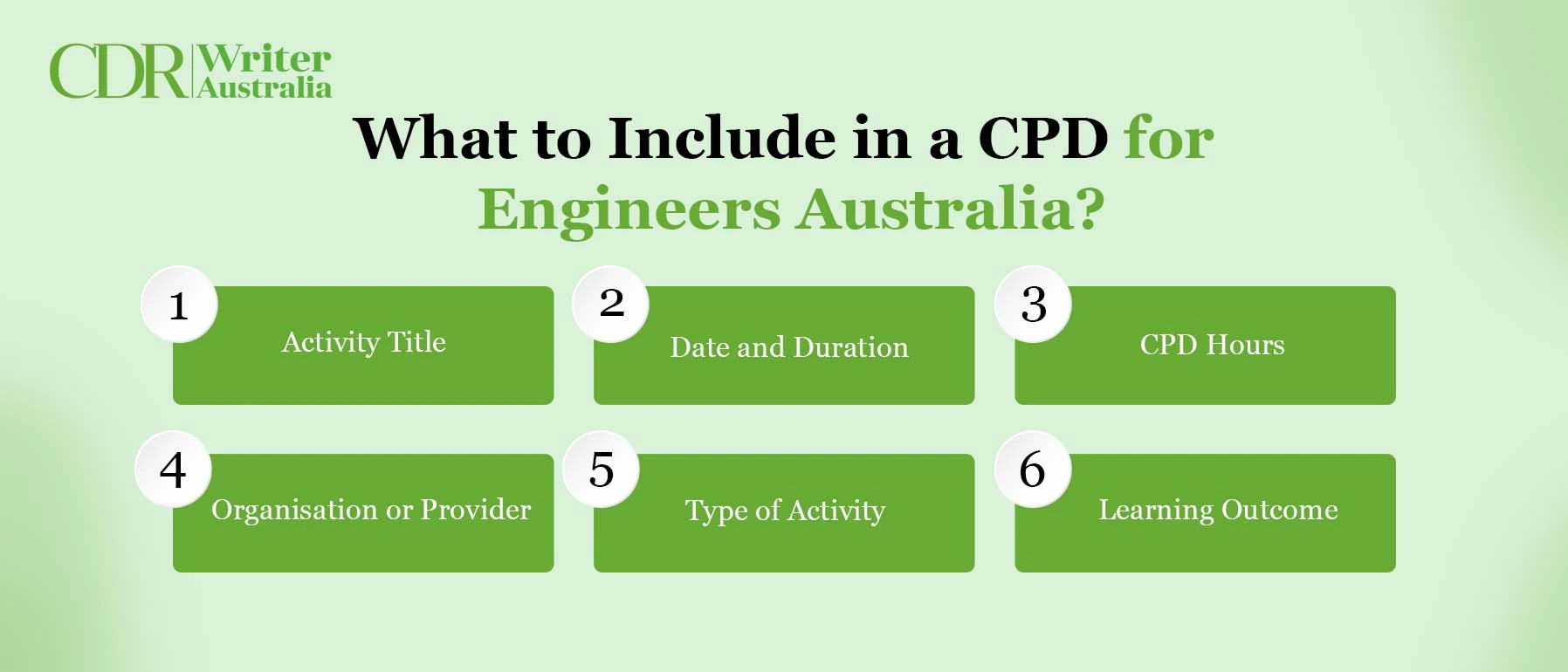
Include the following relevant activities that clearly show how you improved your knowledge and skills in a structured format, following EA guidelines.
- Activity Title: Clearly state the name of the course, training, seminar, or activity so the assessor can identify it easily.
- Date and Duration: Specify when you completed the engineering activity and how long it lasted to show your continuous learning over time.
- CPD Hours: Specify when you completed the activity and how long it lasted to show your continuous learning over time.
- Organisation or Provider: Include the name of the institution, company, or trainer who conducted the activity to confirm its validity.
- Type of Activity: Classify each activity, such as formal education, workshop, work-based learning, or self-directed learning, to show the variety in your learning.
- Learning Outcome: Explain what you learned from each activity and how it improved your engineering knowledge or skills.
What to Include Based on Assessment Type?
CPD requirements remain similar, but the level of detail changes based on the following assessment types.
- For Stage 1 Skills Assessment (CDR):
- Include a short list of relevant activities
- Keep your CPD within one A4 page
- Write simple and clear descriptions
- Focus on relevance instead of total hours
- For NER (National Engineering Register):
- Include detailed records for each activity
- Clearly mention the hours spent
- Meet the required total (150 hours in 3 years or 50 hours in 12 months)
- Show continuous learning over time
- For Stage 2 / Chartered Assessment:
- Include activities that support your professional competency
- Focus on how your learning improves your engineering practice
- Keep your CPD record consistent and updated
Step-by-Step Process to Write a CPD for Engineers Australia
Follow the steps below to write your CPD in an organised way and present your engineering activities effectively in CDR.
First, make a list of all the co-curricular activities you have done. You can also include the activities you have completed after your undergraduate degree.
Some of the Professional activities you can include are:
- Formal Education,
- Work-Based Learning,
- Workshops and Seminars,
- Self-Directed Learning,
- Other Relevant Activities.
Collect all key details for each activity so that the assessor understands your learning without confusion. Make sure all details are correct and relevant.
- Activity title
- Date and duration
- CPD hours
- Organisation or provider
Group your activities into categories such as formal education, work-based learning, or self-study to organise your CPD clearly. This structure helps the assessor review your CPD easily and understand your learning activities without confusion or missing details.
Calculate the actual time you spent on each activity and record the hours accurately for every entry. Make sure the hours reflect your real effort and follow Engineers Australia requirements.
Enter your details into the CPD format or template. Keep each entry short and consistent.
Write a brief learning outcome for each activity to explain:
- What you learned from the activity
- How did the activity improve your engineering skills
Check your CPD to make sure you use clear and simple language, follow the correct format, and include only relevant activities. This way, the assessor can easily understand your CPD without any confusion.
Note: Use the same process for all assessment types, Stage 1, NER and Stage 2 (Chartered) and adjust the level of detail based on your application.
Common Mistakes to Avoid When Writing a CPD for Engineers Australia
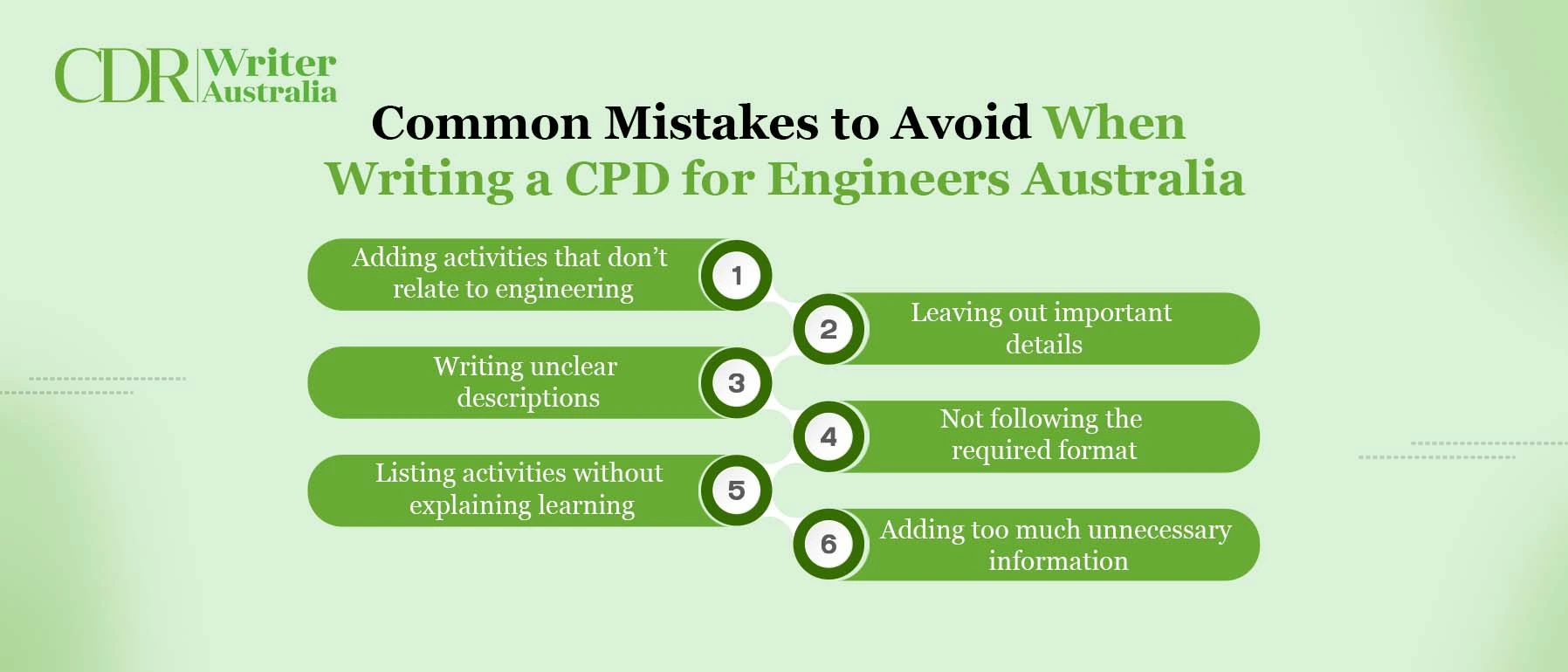
Small mistakes in your CPD can affect your positive assessment outcome. Poorly presented or inaccurate details can make it harder for the assessor to understand your activities, as shown below.
- Adding activities that don’t relate to engineering: Include only activities that build your engineering knowledge or skills. Unrelated entries do not support your application and reduce the quality of your CPD.
- Leaving out important details: Include the activity name, date, duration, CPD hours, and provider so the assessor can review and verify your activity properly.
- Writing unclear descriptions: Use short and clear explanations so the assessor can understand what you learned and how the activity helped you.
- Not following the required format: Stick to a structured format. Keep a consistent structure for all entries so your CPD is easy to read and review.
- Listing activities without explaining learning: Explain what you learned and how it improved your engineering skills, instead of just listing the activity.
- Adding too much unnecessary information: Focus only on relevant details so your CPD stays clear and easy to follow.
Having trouble with EA CPD Writing?
Book your consultationKey Takeaways
Frequently Asked Questions
You do not need to meet a fixed number of CPD hours for Stage 1. You only need to list relevant activities clearly and keep your CPD within one A4 page.
You do not need to attach certificates to your CPD. However, keep them ready as proof in case Engineers Australia asks for verification.
You can include as many activities as needed, but you must meet the required CPD hours and show regular learning over time.
Your CPD helps the assessor understand how you have developed your skills. A clear and well-organised CPD makes it easier to review your learning and supports your overall CDR.
You can balance technical and non-technical CPD activities by focusing mainly on technical learning in your engineering field. Also, add some non-technical activities like communication or management to show your overall development.
What did you think of the article? Anything you agree or disagree with? We would love to hear your thoughts.
Lets Chat

