
Temporary Skill Shortage Subclass 482 Visa Australia Guide
15 minute read
Publish date: 2026/05/15
Aiming to work in Australia in a skilled occupation but unsure which visa fits your job offer? Many skilled workers get stuck when the role needs employer sponsorship, an eligible occupation, and temporary work rights.
That is where the Temporary Skill Shortage (TSS) Subclass 482 visa can help. It gives eligible skilled workers a sponsored pathway to work in Australia when an approved employer nominates them for a role.
In this guide, we explain how the Subclass 482 visa works, who can apply, what employers need to do, and how this visa can lead to permanent residency.
What is the Temporary Skill Shortage Subclass 482 Visa?
The TSS (Subclass 482) visa is an Australian employer-sponsored work visa that allows approved businesses to hire skilled overseas workers for nominated positions. It gives eligible workers temporary work rights in Australia and may support a permanent residency (PR) pathway if applicant meet the stream, occupation, and sponsorship requirements.
Most importantly, Australia replaced the TSS visa with the Skills in Demand visa on 7 December 2024. Still, many applicants know it as the 482 visa. Under the updated 482 visa rules, applicants usually need at least 12 months of relevant work experience. Also, Core Skills roles must meet the salary threshold set by the Department of Home Affairs.
What are the Eligibility Criteria for the Subclass 482 Visa?
To qualify for the Subclass 482 visa, both the worker and sponsoring employer need to meet Home Affairs rules for the job, skills, English level, experience, health, and character.
1. Approved Employer Sponsorship: The employer must have approval to sponsor overseas workers because the 482 visa only works through employer sponsorship.
2. Eligible Occupation: TThe job offer must match an approved occupation because the visa only covers eligible skilled roles under each stream.
3. Relevant Work Experience: At least 12 months of related work experience is usually required because Home Affairs checks whether the worker can perform the nominated role.
4. English Language Requirement: Applicant must meet the required English score to communicate and work safely in Australia.
| English Test | Listening | Reading | Writing | Speaking |
|---|---|---|---|---|
| CELPIP General | 5 | 5 | 5 | 5 |
| IELTS Academic | 5.0 | 5.0 | 5.0 | 5.0 |
| IELTS General Training | 5.0 | 5.0 | 5.0 | 5.0 |
| LANGUAGECERT Academic | 41 | 44 | 45 | 54 |
| Michigan English Test (MET) | 49 | 47 | 45 | 38 |
| Occupational English Test (OET) | 220 | 240 | 200 | 270 |
| PTE Academic | 33 | 36 | 29 | 24 |
| TOEFL iBT | 8 | 8 | 9 | 14 |
Note: These scores apply to tests taken on or after 13 September 2025.
5. Skills and Qualifications: Qualifications, licences, registrations, or technical evidence are required because some occupations need formal training or legal registration.
6. Health and Character Requirement: Medical checks and police clearances are required because Australia checks health and character before granting temporary work visas.
Also Read: Types of Skilled Migration Visa to Australia for International Engineers
What are the Skilled in Demand Subclass 482 Visa Streams?
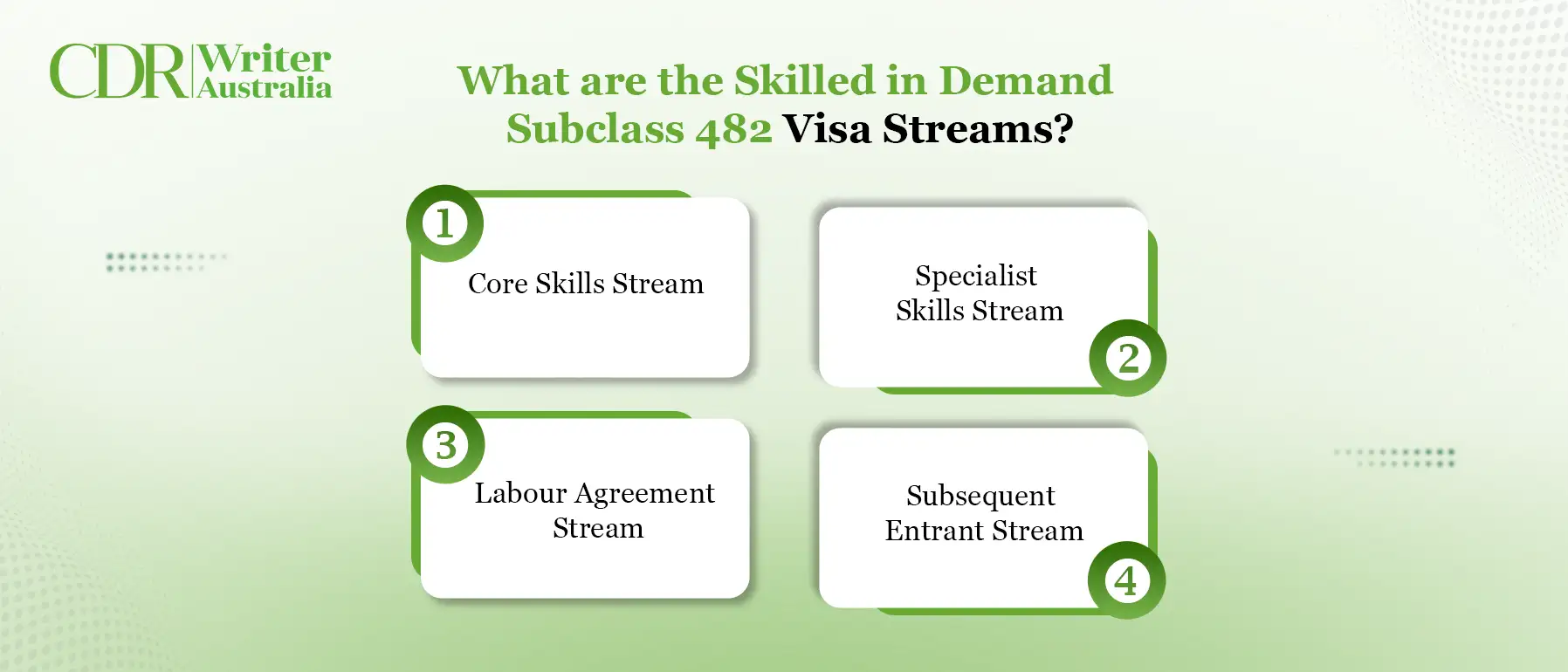
The Skilled in Demand Subclass 482 visa includes four streams: Core Skills, Specialist Skills, Labour Agreement, and Subsequent Entrant. Each stream applies based on the occupation, salary level, labour agreement, or family relationship.
1. Core Skills Stream
The core skills stream applies to sponsored jobs listed on the Core Skills Occupation List. It allows eligible workers to work for their approved sponsor in Australia, travel while the visa remains valid, and apply for PR later if they meet the pathway rules.
| Category | Details |
|---|---|
| Stay |
• Up to 4 years • Up to 5 years for Hong Kong passport holders |
| Cost | From AUD 3,210 |
| Key Eligibility | CSOL occupation, AMSR salary, CSIT minimum salary, 1 year of relevant experience, skills assessment if required, English requirement unless exempt, and work for the sponsor or associated entity |
2. Specialist Skills Stream
The specialist skills stream is for higher-paid sponsored roles that fall under eligible ANZSCO Major Groups 1, 2, 4, 5, or 6. This stream focuses on specialist occupations where the offered salary meets the Specialist Skills Income Threshold
| Category | Details |
|---|---|
| Stay | Up to 4 years, or up to 5 years for Hong Kong passport holders |
| Cost | From AUD 3,210 |
| Key Eligibility | Eligible ANZSCO group, Specialist Skills Income Threshold, 1 year of relevant experience, skills assessment if required, English requirement unless exempt, and work for the sponsor or associated entity |
| What You Can Do |
• Work in Australia, • Study without government assistance, • Travel while the visa is valid, • Apply for PR if eligible |
3. Labour Agreement Stream
The labour agreement stream applies when an employer has a formal labour agreement with the Australian Government. This stream lets skilled workers take up a specified role under the terms agreed between the employer and the Department.
| Category | Details |
|---|---|
| Stay | Up to 4 years, depending on the labour agreement, or up to 5 years for Hong Kong passport holders |
| Cost | From AUD 3,210 |
| Key Eligibility | Occupation specified in the labour agreement, 12 months of relevant full-time work experience unless the agreement says otherwise, skills assessment if required, English requirement unless exempt, and work only for the sponsor |
| What You Can Do |
• Work for the sponsor, • study without government assistance, • travel while the visa is valid, and • Apply for PR through Subclass 186 if eligible |
4. Subsequent Entrant Stream
The subsequent entrant stream allows eligible family members of Subclass 457 or Subclass 482 visa holders to join the primary visa holder in Australia. This stream applies when the partner or dependent applies separately after the main visa holder already holds the visa.
| Category | Details |
|---|---|
| Stay | Stay for the same period as the primary visa holder’s valid visa |
| Cost | From AUD 3,210 |
| Key Eligibility | Must be the partner or dependent of a valid Subclass 457 or Subclass 482 visa holder |
| What You Can Do | Live, work, study, and travel in and out of Australia while the visa remains valid |
How to Apply for the Subclass 482 Visa Step by Step?
The Subclass 482 visa process starts with checking eligibility and securing employer sponsorship. It then moves through nomination, document preparation, visa lodgement, health and character checks, and the final decision.
Step 1: Check Subclass 482 Visa Eligibility
Check whether the job appears under the right 482 stream and whether the worker meets the experience, English, skills, health, and character rules.
Step 2: Get Employer Sponsorship Approval
The employer applies to become an approved sponsor or uses existing sponsorship approval before nominating the role.
Step 3: Submit the 482 Visa Nomination
The employer submits the nominated occupation, salary, work location, visa stream, and business need to Home Affairs.
Step 4: Prepare Subclass 482 Visa Documents
Prepare identity documents, employment proof, qualifications, English test results, skills assessment, medical checks, and police clearances.
Step 5: Lodge the 482 Visa Application
Submit the 482 visa application through ImmiAccount and attach documents that support the nominated role.
Step 6: Complete Health and Character Checks
Complete medical examinations and provide police certificates when Home Affairs requests them.
Step 7: Wait for the 482 Visa Decision
Home Affairs reviews the sponsor, nomination, and visa evidence before granting or refusing the application.
Note: Visa processing times can change based on application volume, occupation checks, and requests from the Department of Home Affairs.
Common Reasons for Subclass 482 Visa Refusal
Subclass 482 visa refusal usually happens when the application does not clearly support the nominated role. The occupation, work history, sponsor details, salary, and documents must all match the same job.
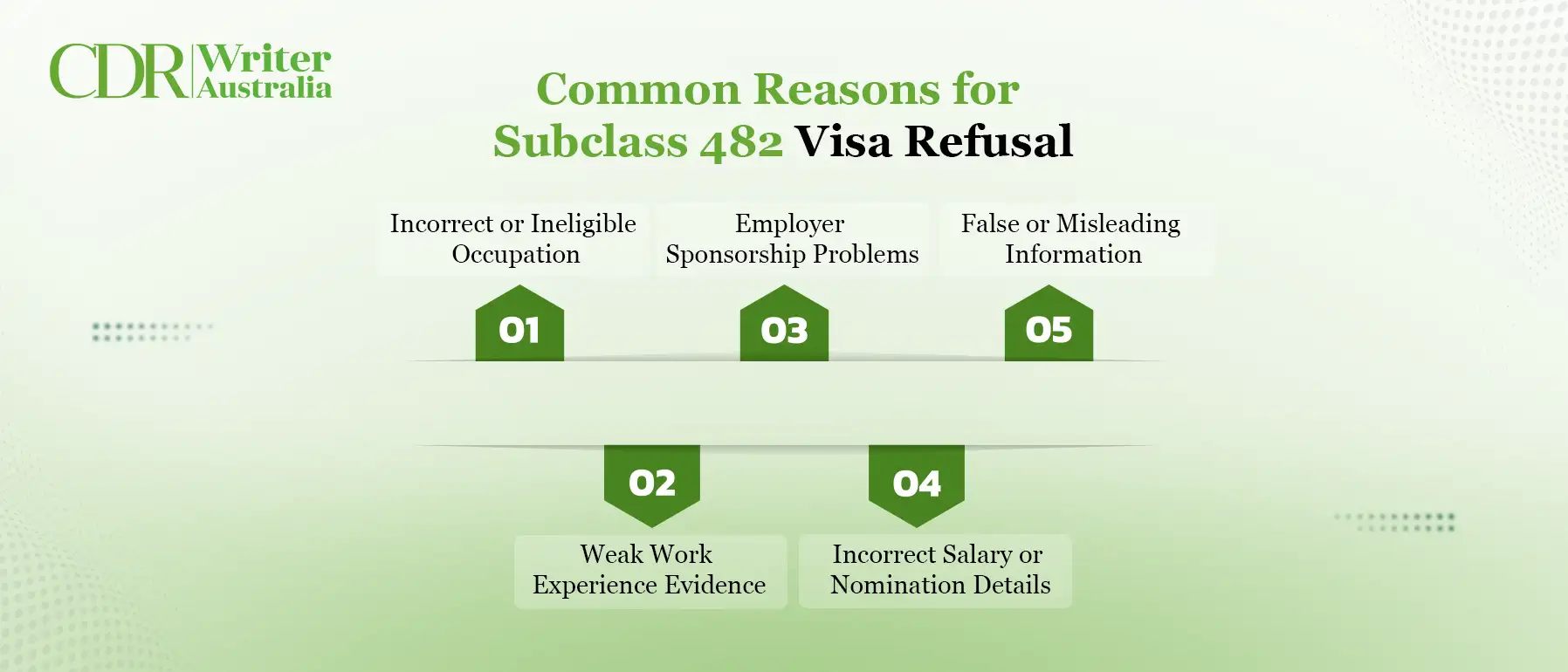
1. Incorrect or Ineligible Occupation: The nominated job must match an approved occupation under the selected 482 visa stream. The job title, daily duties, ANZSCO code, and employer nomination should describe the same role.
2. Weak Work Experience Evidence: Work evidence should show employment dates, job title, duties, hours worked, and relevance to the nominated occupation. Reference letters, payslips, contracts, and tax records should support the same employment history.
3. Employer Sponsorship Problems: The employer must hold valid sponsorship approval and nominate a genuine skilled position. Business details, role duties, salary, and work location should match the nomination.
4. Incorrect Salary or Nomination Details: The nominated salary must meet the required income threshold and match the offered role. The employment contract, nomination form, and salary evidence should show the same pay details.
5. False or Misleading Information: All documents must show accurate employment, education, identity, and sponsorship details. Fake documents or inconsistent claims can affect both the 482 visa and future visa applications.
Key Takeaways
Frequently Asked Questions
Yes, the Subclass 482 visa can lead to PR if the worker meets the employer nomination, occupation, and work experience rules. Many applicants use this visa as a pathway to the Subclass 186 Employer Nomination Scheme visa.
Most 482 visa applicants need at least 12 months of relevant work experience. The experience should relate to the nominated occupation or a closely related role.
Yes, eligible partners and dependent children can join the main 482 visa holder through the Subsequent Entrant stream. They can usually live, work, and study in Australia while the visa remains valid.
No, every 482 visa occupation does not require a skills assessment. Some occupations need a formal skills assessment, so applicants should check the requirement for their nominated role before applying.
Yes, a 482 visa holder can change employers, but the new employer must sponsor and nominate them first. The worker should not start the new role until the required sponsorship and nomination steps are approved.