
Employment Reference Letter for Australian Immigration
15 minute read
Publish date: 2026/04/01
Struggling to prepare an employment reference letter that meets Australian immigration requirements? Many applicants submit generic letters that miss key details like job duties, ANZSCO alignment, or proper formatting.
As a result, assessors delay applications, request additional documents, or reject submissions because the letter does not clearly demonstrate relevant work experience.
In this blog, you will learn how to write a compliant employment reference letter with the right format, key details, and a clear sample.
What is the Employment Reference Letter for Australian Immigration?
An employment reference letter is a document your employer or supervisor writes to confirm your work experience for skilled migration to Australia. It explains your job title, main duties, and the skills you used in your role, not just your employment dates.
Generally, an employment reference letter is considered good when a direct supervisor writes it and clearly describes your responsibilities and the work you performed. It should be issued on company letterhead and include a signature and contact details so assessors can verify it.
Authorities such as Engineers Australia (EA) and the Australian Computer Society (ACS) use this letter to check if your work matches the duties listed for your occupation under ANZSCO and to assess your application.
What is the Purpose of an Employment Reference letter?
The purpose of an employment reference letter is outlined in the following points.
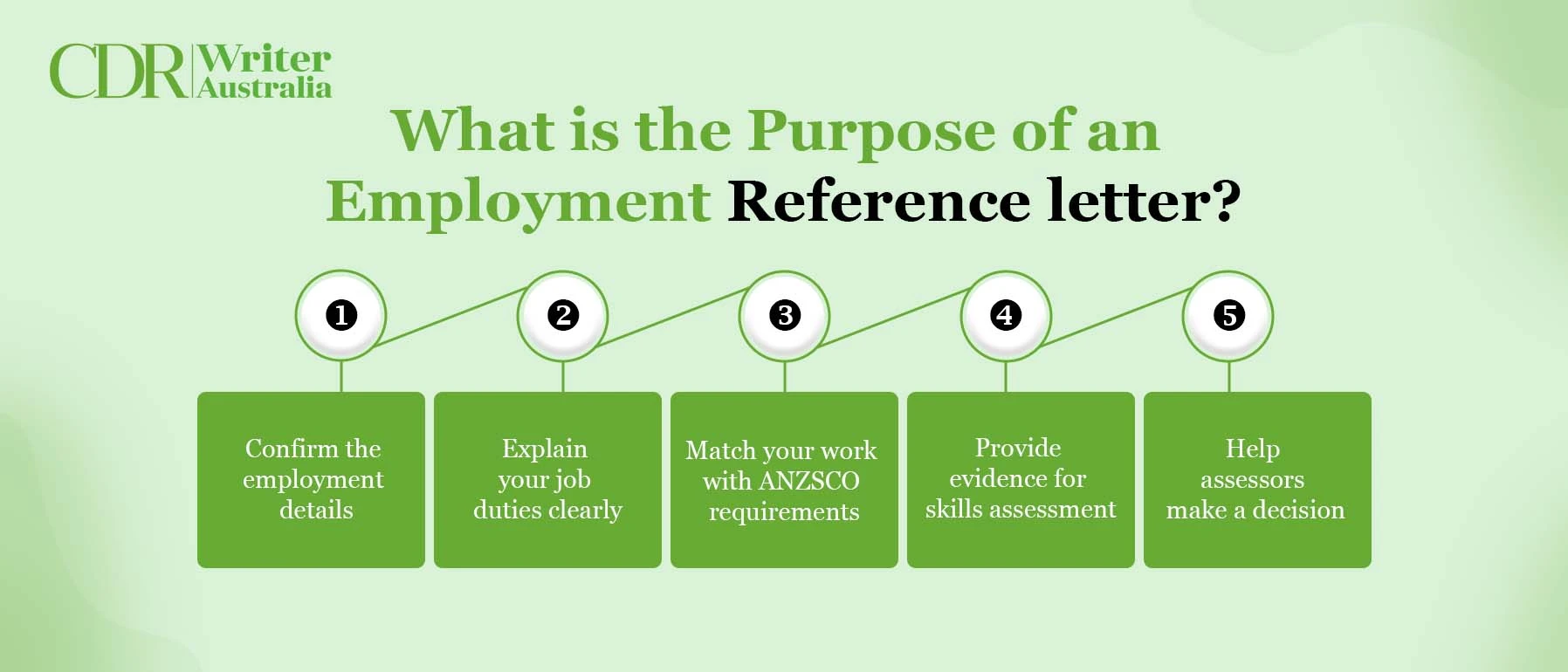
- Confirm the employment details: State your employer, job title, and exact start and end dates so assessors can verify your employment history.
- Explain your job duties clearly: Describe the tasks you handled on a regular basis and show the actual work you performed.
- Match your work with ANZSCO requirements: Helps assessors compare your duties with the ANZSCO description for your nominated occupation.
- Provide evidence for skills assessment: Support your application with documented proof required by EA and ACS.
- Help assessors make a decision: Provide assessors enough information to review your application without asking for additional documents.
What Should Be Included In The Employment Reference Letter For Australian Immigration?
To apply for Australian immigration, you need to include the following clear and verifiable details in your employment reference letter.
1. Employment details (dates and role)
Include your job title along with exact start and end dates in DD/MM/YYYY format.
2. Employer and referee details
Mention the company name, along with the name, position, and contact details of the person writing the letter.
3. Job duties and responsibilities
Clearly describe the tasks you performed on a regular basis. Make sure your duties reflect your actual work and align with your nominated occupation under ANZSCO.
4. Employment type and working hours
Specify whether the role was full-time or part-time and include the number of hours worked per week.
5. Key achievements or projects
Include important contributions, projects, or outcomes that show your role and responsibilities.
6. Company letterhead and signature
Issue the letter on official company letterhead with an authorised signature and verifiable contact details.
Why ANZSCO Alignment Matters in Your Employment Reference Letter?
ANZSCO alignment in your employment reference letter shows if your duties match your nominated occupation. It also helps assessors see that your work experience is relevant.

- Supports a positive skills assessment: Assessors compare your listed duties with the ANZSCO description to decide whether your experience meets the required standards.
- Confirms relevant work experience: Your responsibilities must match the key tasks defined under ANZSCO for your occupation to be considered valid.
- Keeps your documents consistent: Your reference letter, CDR, and CV should all reflect duties that align with the same ANZSCO occupation to avoid confusion.
- Focuses on duties over job titles: ANZSCO defines roles based on tasks, so assessors rely on your duties rather than your job title to evaluate your experience.
- Avoids generic or copied content: Instead of copying ANZSCO descriptions, clearly explain your actual work in your own words while keeping it aligned with the role requirements.
How to Prepare an Employment Reference Letter for Australian Immigration?
Follow these steps to prepare your employment reference letter correctly:
Step 1: Check the Requirements First
Start by reviewing what Engineers Australia (EA) or the Australian Computer Society (ACS) expects. Make sure you understand the required details such as job duties, employment dates, and contact information.
Step 2: List your Actual Job Duties
Write down the tasks you performed in your role. Focus on your daily responsibilities so your work experience is clear and easy to understand.
Step 3: Align your Duties with your Document
Make sure your reference letter matches the information in your CDR, CV, and other documents. This helps avoid confusion during assessment.
Step 4: Draft the Reference Letter
Prepare a structured draft that includes all required details. Use clear language and describe your work in your own words instead of copying from other sources.
Step 5: Share the Draft with your Employer
Send the draft to your employer or supervisor so they can review the content and confirm that it reflects your role accurately.
Step 6: Get the Letter Finalised and Signed
Ask your employer to issue the letter on company letterhead, sign it, and include contact details so assessors can verify the information.
Already prepared your reference letter?
Get it reviewed by CDR Writer Australia to check
alignment with skills assessment requirements.
Employment Reference Letter Requirements for EA and ACS Skills Assessment
If you are applying for an EA or ACS Skills Assessment, you may need to provide an employment reference letter to support your application. Assessors strictly rely on this letter to understand your work experience and decide if it matches your nominated occupation.
1. For EA Skill Assessment
Engineers Australia expects your reference letter to support the work experience you describe in your Career Episodes and Summary Statement. To meet EA requirements, your employment reference letter should include the following details:
- Clearly states your job title and employment period
- Describe your engineering duties in detail so your role is easy to understand
- Reflects the work you explained in your CDR and Summary Statement
- Shows your involvement in projects and technical tasks
- Uses company letterhead with a signature and contact details for verification
Sample Employment Reference Letter for EA
[Company Letterhead]
[Company Name]
[Company Address]
[City, State, Postcode]
[Contact Number]
[Email Address]
[Date]
To Whom It May Concern,
This letter confirms that [Applicant Name] worked with [Company Name] as a [Job Title] from [Start Date] to [End Date], on a full-time basis ([X] hours per week).
During this period, [Applicant Name] carried out engineering duties related to [field, e.g. civil/mechanical/electrical engineering]. Their role involved planning, designing, and executing engineering tasks as part of various projects.
Key responsibilities included:
- Designing and developing [systems/structures/components] based on project requirements
- Preparing technical drawings, calculations, and reports
- Analysing project specifications and ensuring compliance with engineering standards
- Coordinating with project teams, contractors, and stakeholders
- Monitoring project progress and resolving technical issues
- Using tools and software such as [AutoCAD, MATLAB, SolidWorks, etc.]
[Applicant Name] actively contributed to projects such as [Project Name or Description], where they were responsible for [specific contribution]. Their work required problem-solving, technical decision-making, and applying engineering principles in real scenarios.
Throughout their employment, [Applicant Name] demonstrated a strong understanding of engineering concepts and consistently performed their duties with professionalism.
If you require any further information, please feel free to contact us.
Sincerely,
[Name of Referee]
[Position]
[Company Name]
[Signature]
2. ACS Skill Assessment
The Australian Computer Society reviews your reference letter to verify your ICT work experience. To meet these requirements, your employment reference letter should include the following details:
- Includes your job title, employment dates, and employer details
- Clearly explains your ICT duties and responsibilities
- Mentions the tools, technologies, or systems you used in your role
- Shows that your duties match your nominated ICT occupation
- Includes a signature and contact details so assessors can verify it
Sample Employment Reference Letter for ACS Skill Assessment
[Company Letterhead]
[Company Name]
[Company Address]
[City, State, Postcode]
[Contact Number]
[Email Address]
[Date]
To Whom It May Concern,
This letter confirms that [Applicant Name] worked with [Company Name] as a [Job Title] from [Start Date] to [End Date], on a full-time basis ([X] hours per week).
During this period, [Applicant Name] performed ICT-related duties focused on [e.g., software development/system administration/network engineering]. Their role involved designing, developing, and maintaining systems to support business and technical requirements.
Key responsibilities included:
- Developing and maintaining applications using [programming languages such as Java, Python, C#, etc.]
- Designing system architecture and implementing software solutions
- Managing databases using tools such as [MySQL, PostgreSQL, Oracle]
- Troubleshooting system issues and providing technical support
- Testing, debugging, and improving system performance
- Working with tools and technologies such as [frameworks, cloud platforms, version control systems]
[Applicant Name] contributed to projects such as [Project Name or Description], where they were responsible for [specific contribution]. Their work required applying technical knowledge, problem-solving skills, and working with modern ICT tools.
Throughout their employment, [Applicant Name] demonstrated strong technical capability and handled their responsibilities effectively.
If you require any further information, please feel free to contact us.
Sincerely,
[Name of Referee]
[Position]
[Company Name]
[Signature]
Note: There is no fixed length for an employment reference letter, but it should clearly describe your duties. It must be in English or include a certified translation and be free from errors.
Key Takeaways
Table of Content
- Employment reference letter Australian Immigration
- The Purpose of Employment Reference letter
- What Should Be Included In The Employment Reference Letter For Australian Immigration?
- Why ANZSCO Alignment Matters in Your Employment Reference Letter?
- How to Prepare an Employment Reference Letter for Australian Immigration?
- Employment Reference Letter Requirements for EA and ACS Skills Assessment
- Key Takeaways
- FAQs
Frequently Asked Questions
Yes, you can submit separate reference letters for each job or role. Each letter should clearly explain what you did in that role and how long you worked there.
If your employer cannot provide a letter, you can use a statutory declaration along with supporting documents like payslips, contracts, or emails to show your work experience.
Salary details are not always required, but adding them can make your letter more credible and help support your employment claims.
You can use the same base letter, but you should adjust the duties and details so they match the specific requirements of EA or ACS.
If your duties do not match your nominated occupation, assessors may not accept your work experience, which can affect your assessment result.