
Australian Job Market Trends in 2024
28 minute read
Publish date: 2024/09/29
Are you curious about job market trends in Australia?
The Australian job market is constantly evolving due to the economic boost, technological advancements and skill enhancement in the workforce. These factors drive growth across various sectors, creating new opportunities and making living in Australia beneficial.
Staying informed about the trends helps job seekers match their skills with industry demands, and make strategic decisions. These decisions can overcome challenges faced by job seekers.
Let’s explore this article to learn about current job market trends in Australia, highlighting in-demand occupations.
Top 8 Occupations With the Most Job Openings
The Australian job market offers many job vacancies across various industries. Here are the 8 top occupations that have the most job openings:
ABS Labour Force data shows over 1.8 million people are employed as managers across various companies. They are skilled in communication, planning, budgeting and problem-solving. Their invaluable skills keep them in high demand, and they are one of Australia's highest-paying occupations.
Popular managerial roles are:
-
Retail Managers
Retail managers supervise retail operations, manage staff and ensure customer satisfaction.
The growth of businesses in urban centres and shopping hubs has further increased the job openings for retail managers.
-
Advertising, Public Relations and
Sales Managers
Advertising, public relations and sales managers develop marketing strategies and manage sales teams.
As social media has become a popular platform for advertisement, you can find job openings for these managerial posts. They handle media relations and manage the company's image to reach broad and diverse audiences.
-
Construction Managers
Construction managers are responsible for planning and coordinating construction projects. They handle various infrastructural, commercial, industrial and residential building projects.
The Australian job market has a high demand for construction managers due to ongoing infrastructure developments, urbanisation and population growth.
Top employing occupationsOccupation Feb 2024 employment data Average annual salary range (AUD) Retail Managers 243,700 $65k - $75k Advertising, Public Relations and Sales Managers 176,300 $80k - $125k Construction Managers 127,300 $185k - $205k
Professional service providers are the largest occupation group in the Australian job market. They perform analytical, conceptual and creative work across diverse industries like healthcare, IT, finance, education, etc.
Popular professional service jobs are:
-
Registered Nurses
Registered Nurses (RNs) provide essential medical care and support to patients. Nursing positions are frequently available in hospitals, clinics, aged care facilities, and home healthcare services.
-
Accountants
Accountants manage financial records and ensure compliance with tax laws. They often provide financial advice to individuals and businesses.
Accountants have high job opportunities in accounting firms, corporate financial departments and government agencies.
-
Primary School Teachers
Primary school teachers specialising in mathematics, technology, and science are the most in-demand professionals.
There is a high demand for primary school teachers in public and private schools across urban and regional areas.
Top employing occupationsOccupation Feb 2024 employment data Average annual salary range Registered Nurses 325,500 $85k - $90k Accountants 198,800 $70k - $90k Primary School Teacher 163,000 $95k - $105k
Technicians and Trades (T&T) workers perform technical tasks at construction, manufacturing, science and engineering sites.
As of February 2024, technicians and trade workers comprised approximately 13.4% of the total workforce. However, JSA Internet Vacancy Index data showed online job vacancies of 32400. It had declined by 18.6% over the year to April 2024. The 2021 data mentioned a 33% skill shortage, the highest in all occupations.
Popular technical jobs are given below:
-
Electricians
Electricians are in high demand for their expertise in installing, maintaining, and repairing electrical systems across residential, commercial, and industrial settings.
-
Carpenters and Joiners
Job opportunities for carpenters and joiners are high at construction and renovation companies. They can also work as independent contractors, often earning a competitive salary.
-
Metal Fitters and Machinists
Metal fitters and machinists have high job opportunities in manufacturing, mining, and heavy industry.
Top employing occupationsOccupation Feb 2024 employment data Average annual salary range Electricians 185,000 $90k - $110k Carpenters and Joiners 141,500 $65k - $85k Metal Fitters and Machinists 118,700 $70k - $90k
Community and personal service workers provide services in aged care, health and social welfare, hospitality, policing, tourism, sports and personal services.
The ABS quarterly data showed the employment of over 1.6 million CPS workers in Feb 2024. Community and personal service workers comprise around 11% of online job vacancies.
Popular Community and Personal Service jobs are:
-
Aged and Disabled Carers
Aged and Disabled Carers are often in high demand due to the large population of elderly residents. They provide personal care, monitor health conditions, and administer medications for elderly and disabled individuals.
-
Child Carers
Childcare workers play a crucial role in infants and young children's social and educational development.
These workers are in demand in various sectors such as childcare, hospitals, and educational centres. They often have flexible working hours and may work different shifts, including evenings and weekends.
-
Waiters
As the number of restaurants, cafes, bars, and hotels increases there are many vacancies for waiters and waitresses. They often offer flexible working hours.
Top employing occupations:Occupation Feb 2024 employment data Average annual salary range Aged and Disabled Carers 314,600 $60k - $70k Child Carers 123,000 $55k - $70k Waiters 127,000 $65k - $75k
Clerical and administrative workers are essential for the smooth operation of businesses in the Australian job market.
Individuals with excellent communication and interpersonal skills, and basic office software proficiency, are preferred for the job. They handle various tasks, from basic office duties to more complex administrative responsibilities.
Popular Clerical and Administrative jobs are given below:
-
General Clerks
There is a high demand for clerks in corporate offices, government agencies, and small businesses to perform administrative tasks. One has to be good at office software and organisational skills.
-
Receptionists
Receptionists have a strong future demand of about 86%. They have strong future demand including Medical Receptionists, General Receptionists, Call Centre Team Leaders and Operators.
-
Contract, Program, and Project
Administrators
There is a growing demand for administrators in construction, IT, healthcare, and government industries. They must have project management skills and relevant certifications like PRINCE2 or PMP.
Top employing occupationsOccupation Feb 2024 employment data Average annual salary range General Clerks 294,400 $50k - $60k Receptionist 189,000 $55k - $65k Contract, Program and Project Administrators 161,400 $70k - $135k
Sales workers are vital for businesses to engage customers and drive revenue across various sectors i.e. supermarkets, retail stores, grocery stores, and department stores.
Over 1.1 million people are employed as sales workers, making up around 7.69% of the total employment.
Popular sales jobs:
-
Sales Assistants (General)
Sales assistants are in high demand in Australia due to store turnover and expansion. They should be skilled in handling transactions and effective communication to help maintain the store's environment.
-
Checkout Operators and Office
Cashiers
Checkout Operators and Office Cashier positions are in high demand in supermarkets, grocery stores, and retail outlets. Candidates with strong basic math skills and good customer service abilities are preferred for these roles.
-
Real Estate Sales Agents
Real Estate Sales agents have job opportunities in residential properties (houses and apartments) and commercial sectors (office buildings).
Top employing occupationsOccupation Feb 2024 employment data Average annual salary range Sales Assistants (General) 556,500 $55k - $65k Checkout Officers and Office Cashiers 134,900 $55k - $60k Real estate sales agent 99,300 $90k - $110k
ABS Labour force data shows that employment of machinery operators and drivers grew by 4.4% over the past 12 months till Feb 2024.
Many large-employing occupations currently face a skills shortage, including truck drivers, drillers, miners, shot firers, and crane operators.
Various roles that fall under this occupation are:
-
Truck Drivers
Truck drivers are often needed in the logistics and freight industries. They must have a valid truck driving licence, and time management skills.
With a male-dominated workforce and demanding physical requirements, only 5% of truck drivers in the Australian job market are women.
-
Store Persons
For the efficient operation of warehouse activities, store persons are highly required in the retail, manufacturing, and logistics sectors. They must have skills in operating forklifts and other machinery to move heavy materials efficiently.
-
Delivery Driver
The growth of online businesses and prompt-to-home delivery services have increased the need for delivery drivers. These positions require strong navigation skills and exceptional customer service.
Top employing occupationsOccupation Feb 2024 employment data Average annual salary range Truck Drivers 199,200 $65k - $85k Store Persons 160,600 $55k - $65k Delivery Drivers 86,000 $55k - $65k
Labourers perform various manual tasks across multiple industries, including construction, agriculture and manufacturing.
Over the 3 months to Feb 2024, the employment number of labourers increased by 2.41%. They are in high demand in construction and agricultural activities.
The JSA vacancy report showed online vacancies declined by 26.1% over a year, marking the highest decrease among all occupations.
Popular roles within the labourer category include:
-
Commercial Cleaners
The rise in institutions and commercial establishments across Australia is increasing the need for commercial cleaners.
This growth emphasises the vital role of cleanliness and hygiene in maintaining a healthy and efficient environment.
-
Kitchen Hands
The job opportunities for kitchen hands are high in the hospitality industry, Corporate Cafeterias, and tourist areas. More than 50% of females share employment in Australia as kitchen hands.
-
Shelf Fillers
Shelf fillers are responsible for arranging products, checking expiration dates, and ensuring shelves are well-presented. The job often involves working off-hours to restock the shelves.
The continuous need to maintain store inventories creates demand for shelf fillers.
Top employing occupationsOccupation Feb 2024 employment data Average annual salary range Commercial Cleaners 150,200 $55k- $65k Kitchen Hands 147,000 $50k - $70k Shelf Fillers 70,300 $50k - $70k
Top 5 Industries With the Most Job Market Share in Australia
Let’s discover the top 5 industries with the most job opportunities across the Australian job market.
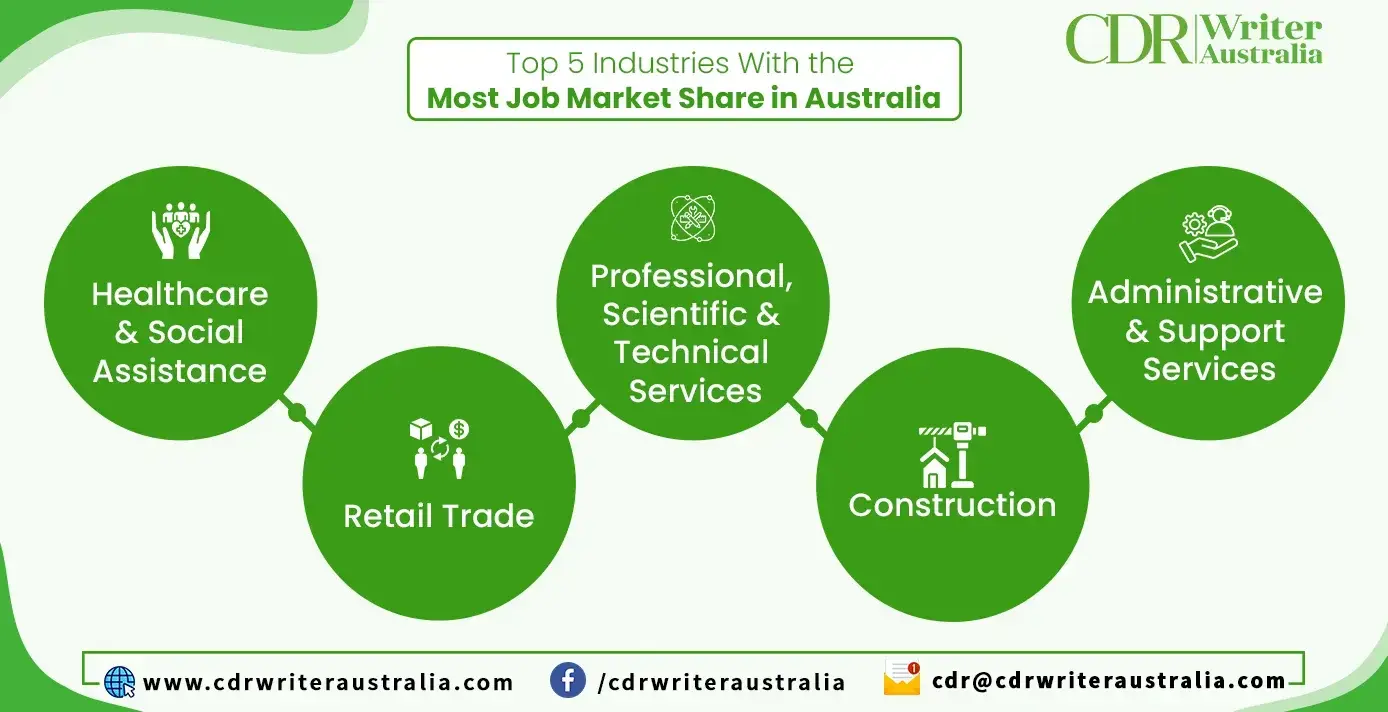
Health Care and Social Assistance is Australia’s largest employing and fastest-growing industry.
The industry comprises both private and public sector operators. Working in this industry often involves community or home-based roles and can be done in various settings, including medical centres, hospitals, etc.
Major Highlights:| Employment Statistics | As of 2024, this industry employs around 2,224,400 healthcare and social assistance, approximately 15.6% of the workforce. |
| Available Occupations |
|
| Median Earnings | The median earnings of healthcare and social assistance are $1,248 per week. It is below the all-industry median of $1300. |
Professional, scientific, and technical services are a large employment industry. The industry is essential for supporting other enterprises with expert knowledge and skills.
The industry includes various sectors that provide high-quality services to domestic and international clients. Computer System Design and Related Services is the largest sector in the Australian job market, employing around 351,600 workers.
Major Highlights:| Employment Statistics | As of 2024, this industry employs around 1,322,600 workers, approximately 9.3% of the workforce. |
| Available Occupations |
|
| Median Earnings | The median earnings for workers are $1726 per week, higher than all industry's median earnings of $1,600. |
Want to know how much civil engineers earn? Read here.
Note: If you are interested in technical sectors, CDR is a crucial step toward establishing your professional career.
Retail trade is the second largest employment industry in Australia. These businesses primarily buy and resell goods to the public. It includes an increasing number of supermarkets, shopping centres, convenience stores, online shopping and franchises. Many jobs in retail are casual, part-time, or seasonal in the Australian job market.
Major Highlights:| Employment Statistics |
As of 2024, this industry employs around 1,320,300 workers, approximately 9.2% of the workforce. The number of workers grew by 108,000 (5.1%) over the last year. |
| Available Occupations |
|
| Median Earnings | The average earnings for workers is $1,229 per week. It is lower than all industries' median earnings of $1,600. |
The administrative and support services industry provides essential routine support for businesses and organisations. Most service providers in this sector employ fewer than 20 people. However, the building cleaning, pest control, and gardening services employ a significant number of workers, making them the largest sector in the industry.
Major Highlights:| Employment Statistics | As of 2024, this industry employs around 437,600 workers, only 3% of the total workforce. |
| Available Occupations |
|
| Median Earnings | The median earnings for workers are $1,400 per week. It is below the all-industry median of $1,600. |
Construction is also a large industry in Australia, employing over a million workers. The number of employees increased by 2.8% over the last year in the Australian job market. For those working in Australia, the construction sector offers a wide range of opportunities, contributing substantially to the country's economy.
Building Installation Services is the largest sector in the Construction industry, employing 307,000 workers.
Major Highlights:| Employment Statistics | As of 2024, this industry employs around 1,357,700 workers, approximately 9.5% of the total workforce. |
| Available Occupations |
|
| Median Earnings | The median earnings for workers are $1,538 per week. It is higher than the median earnings of all industries, which is $1600. |
Are you looking for the best CDR writers?
CDR Writer Australia is right here at your service. We prepare your report strictly according to EA guidelines.
Contact usIndustry Overview (2024):
| Industry | Australian Workforce (%) | Female Share of workers (%) | Part-time share of workers (%) | Median age of workers | Job vacancies (‘000) |
|---|---|---|---|---|---|
| Healthcare and Social Assistance | 15.6% | 77% | 43% | 40 | 65.0 |
| Professional, Scientific and Technical Services | 9.3% | 43% | 20% | 39 | 34.6 |
| Retail Trade | 9.4% | 55% | 50% | 33 | 32.1 |
| Administrative and Support Services | 3% | 53% | 40% | 41 | 30.0 |
| Construction | 9.4% | 13% | 15% | 37 | 27.9 |
The table showcases Australia’s industry employment data and job vacancies. This data is relevant for all job hunters new to the Australian job market for individuals planning to study in Australia and embark on their career journey, this table is a valuable guide in selecting a preferred industry that suits your professional aspirations.
Additionally, the Australian job market is vast and provides job opportunities for workers at every level. If you are a new migrant, Australia also offers job opportunities for skilled migrants. Explore top jobs for skilled migration.
Key Takeaways
Frequently Asked Questions
Several government initiatives support job seekers in Australia. They are:
- Workforce Australia
- Services Australia
- Jobactive
- Youth Jobs path
- Fair work ombudsman
- Career Transition Assistance
Individuals can follow various ways to prepare for the increasing demand for specific skill sets:
- Training courses and workshops
- Volunteering
- Research
- Find a Mentor
- Video content
- Webinars
High-demand skills in Australia are:
- Data analysis
- Cybersecurity skill
- Programming and software development
- Healthcare
- Project management
- Customer Service
Follow these steps to find a job in Australia:
- Researching the Australian Job Market
- Exploring Online Job Portals or Platforms
- Networking Strategies
- Skill Enhancement and Certification
- Enlist the Recruitment Agency
To explore more tips to find a job in Australia, check out our article “How to find a job in Australia for 2024”.
The cities with the highest employment opportunities in Australia are:
- Sydney
- New South Wales (NSW)
- Victoria (VIC)
- Queensland (QLD)
- Western Australia (WA)
- South Australia (SA)
- Australian Capital Territory (ACT)
What did you think of the article? Anything you agree or disagree with? We would love to hear your thoughts.
Lets Chat
