
Studying in Australia
12 minute read
Publish date: 2024/09/13
Studying in Australia is a golden opportunity to unlock your potential and open doors to a future full of possibilities.
Universities in Australia are well-regarded for their excellent education system, offering diverse programs in various fields with a top-notch learning environment.
Let’s go through all the necessary information and guide to study in Australia.
Overview of Australian Education
Australia's education system is globally renowned for its diverse and high-quality education.
Australian universities have two major intakes for domestic and international students:
Semester 1 intake typically begins in late February or early March, with enrollment usually opening in November or December of the previous year. This allows prospective students to apply and secure their places well in advance.
Semester 2 intake usually starts in July, and the enrollment period generally opens in April or May. It gives students another opportunity to begin their studies later in the year.
Overall, studying in Australia strongly emphasises excellence, innovation and preparing students for successful careers.
Step-by-Step Guide to Study in Australia
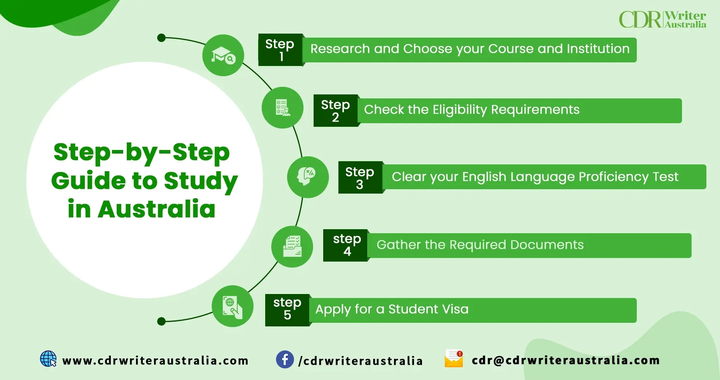
Here are the step-by-step guides you can follow to study in Australia:
If you are still deciding which course to pursue, here are some useful tips to help you choose the best degree to study in Australia for better career decisions.
- Ensure the chosen course aligns with your interests and long-term career goals.
- Evaluate the course’s career-practical relevance to your chosen career and its market demand.
- Research employment rates for the chosen course and explore programs or institutes offering internships or job placement.
- Thoroughly review the course curriculum to ensure it aligns with your career objectives and provides relevant skills.
As an international student in Australia, managing your expenses can be difficult. Consider choosing an affordable course to study that can help you manage your budget better.
While selecting a university for your preferred course, consider the following factors:
- Create a list of the most expensive and affordable universities offering the desired course, and consider your cost of living when choosing among them.
- Evaluate each university on key factors including its accreditation status, location, fee structure, etc.
- Connect with individuals currently enrolled in the same course and inquire about available scholarships or special programs.
To pursue your dream course in Australia, it is essential to check the eligibility requirements, which vary depending on the level of study and the institution you choose.
Ensure you meet the academic qualifications required to join the course. Also, you need to prepare the essential documents, including:
- English language proficiency,
- Relevant degrees or diplomas,
- Passports,
- Financial capacity to cover tuition fees and living expenses.
English language proficiency test is an essential requirement for studying in Australia. The Australian government widely accepted several standardised tests, as listed below. You are only required to take one from the following list:
- IELTS (International English Language Testing System)
- TOEFL (Test of English as a Foreign Language)
- PTE (Pearson Test of English Academic)
- CAE (Cambridge English Exam)
Before diving into any exam, you should research the English language proficiency test requirements.
Once you have decided on the course and university, it is time to gather the required documents accordingly, such as:
- Academic Transcripts and Certificates
- English Language Proficiency Test Results
- Passport
- Letters of Recommendation (LOR)
- Medical Reports
- Financial Documents
- No Objection Letter (NOC)
- Statement of Purpose (SOP)
- Additional Documents
Note: You may require additional documents depending on the visa types and their specific requirements.
After you get Confirmation of Enrollment (CoE) from the applied Australian University, you can now apply for your student visa. The sooner you apply, the sooner you will get a visa decision and move to Australia.
Submit your application to the Department of Home Affairs with all the necessary documents. Remember to fulfil all health and character requirements sticking with the application process for a successful transition to studying in Australia.
Also Check Out: Living in Australia
Benefits of Studying in Australia

Let’s delve into the benefits of studying in Australia.
World-Class Education
Australia hosts top-ranked universities globally, such as the University of Melbourne, the Australian National University and many other universities. These institutions are renowned for providing high-quality education.
Universities in Australia offer work placements and internships, ensuring that students gain practical experience alongside their academic studies. This blend of academic excellence and real-world application makes Australia's higher education system highly attractive to international students.
Career and Research-Oriented Programs
Australian education provides career-focused and research-based programs that empower students to succeed in a rapidly changing global landscape.
The curriculum enhances students’ communication skills, problem-solving ability, and knowledge in their respective fields.
Additionally, some universities promote multicultural environments and global networking opportunities to broaden students’ perspectives.
Post-Study Opportunities
Post-study opportunities including staying and working in Australia mainly depend on the following level of qualification:
- Bachelor’s and master’s graduates are valid for 2-4 years.
- Master’s by Research graduates are valid for 3-5 years.
- Doctoral (Ph.D.) graduates are valid for 4-6 years.
These post-study work opportunities offer graduates a chance to gain valuable Australian work experience and build professional networks.
Support for International Student
Studying in Australia ensures robust support for international students, prioritising their needs for a smooth and rewarding experience in University. These services include academic support, counselling and other practical assistance.
Additionally, most universities offer flexible options, allowing students to change programs within a specific period if desired.
Safe and Diverse Environment
Australia’s reputation for a safe and diverse environment makes it an ideal destination for international students. This country has a relatively low crime rate, so students can feel safe studying in Australia.
Australia accepts multiculturalism and embraces diversity. This enriches students by teaching them about different cultures and expands their knowledge. Moreover, this environment fosters a sense of belonging and promotes intercultural understanding.
Student Development
Studying in Australia offers numerous opportunities for personal growth, leadership skills and teamwork. Universities and colleges provide various activities, including clubs and societies catering to multiple interests, helping students build valuable networks.
Immense Career Opportunities
Australia's strong economy and thriving job market trend make it a top choice for international students. The country offers high employability degrees, especially in engineering, healthcare, information technology and many more.
It focuses on developing industry-relevant skills and providing international students with numerous internship and work placement opportunities.
Affordable Course Fees
When considering to study in Australia, it is important to note the course fees. The course fee depends on factors such as the type, level of education, and location of the institute.
On average, the cost of a bachelor's degree ranges from 20,000 to 45,000 AUD per year. A Master's degree can range from 22,000 to 50,000 AUD per year.
As an international student in Australia, managing your expenses can be difficult. Consider choosing an affordable course to study that can help you manage your budget better.
Scholarships Availability
Many Australian universities and the Australian government sponsor numerous scholarships for international students. The scholarships are based on various factors such as academic merit and provide financial support for specific areas of study, research projects, and cultural diversity.
These scholarships support tuition fees, living allowances, and sometimes even travel and other expenses. This makes studying in Australia more accessible for international students.
Key Takeaways
Frequently Asked Questions
Yes, you can change your course or educational institution after obtaining an Australian student visa. But you need to inform the Department of Home Affairs about your intention.
Yes, you can apply for permanent residency in Australia after completing your studies on a student visa. The Australian government has a policy that allows for a transition from a student visa to permanent residency.
If you are curious about which course to study in Australia for PR, it's important to consider programs that align with Australia's skilled occupation list.
Minimum age limit: You must be 6 years or older to apply for student visas in Australia. However, if you are under 18, you must provide proof of a welfare arrangement.
Most universities in Australia accept a study gap of 1-2 years. But if the gap is more, like 3-4 years then you must justify. However, some colleges and universities accept a gap of over 5 years for postgraduate courses.
Yes, you can study in Australia without taking an English proficiency test, but it depends on specific conditions set by the university or course. Some universities may offer alternative pathways, such as:
- Study in an English-speaking country
- Work experience in an English-speaking country
- Students with accredited qualifications
Popular destinations for international students in Australia include cities like Melbourne, Sydney, Brisbane, and Adelaide, known for their universities and vibrant student lives.
What did you think of the article? Anything you agree or disagree with? We would love to hear your thoughts.
Lets Chat