
CDR Report Mistakes Engineers Must Avoid
12 minute read
Publish date: 2026/07/02
Many engineers invest significant time and effort in building their qualifications and professional experience, yet their CDR report may not accurately reflect their capabilities. A well-qualified engineer can still face challenges during the skills assessment process if their report fails to clearly demonstrate their competencies, achievements, and individual contributions.
To help you avoid common CDR report writing mistakes, it is important to understand the issues that can weaken a submission. Weak Career Episodes, poor competency demonstration, plagiarism, and incorrect formatting are some of the common factors that can negatively impact the assessment outcome.
In this guide, you will learn about the most common CDR report mistakes and the practical steps you can take to avoid them and strengthen your CDR submission.
Why is it Important to Avoid CDR Report Writing Mistakes?
Avoiding CDR report writing mistakes is important because errors can weaken your application, prevent unnecessary assessment delays and affect your Engineers Australia skills assessment outcome.
1. Showcases Your Engineering Competencies Clearly
The primary purpose of a CDR is to demonstrate your engineering skills and abilities. Mistakes such as vague project descriptions or insufficient technical details can make it difficult for assessors to identify your competencies.
2. Reduces the Risk of Rejection
Mistakes such as copied content, weak evidence, unclear technical details, or poor structure can increase the risk of CDR rejection . Avoiding these issues helps you submit an original, complete, and credible CDR that clearly demonstrates your engineering competencies and meets EA assessment requirements.
3. Prevents Unnecessary Assessment Delays
Errors such as incomplete information, poor formatting, inconsistent details, or missing documents may result in requests for clarification or additional evidence. Avoiding these issues helps streamline the assessment process and reduces the likelihood of delays.
4. Saves Time, Effort, and Additional Costs
Correcting mistakes after submission can require significant time and effort. In some cases, applicants may need to revise documents or submit a new application. Preparing a high-quality CDR from the beginning can help avoid unnecessary delays, stress, and additional expenses.
What are the Common Mistakes in CDR Reports?
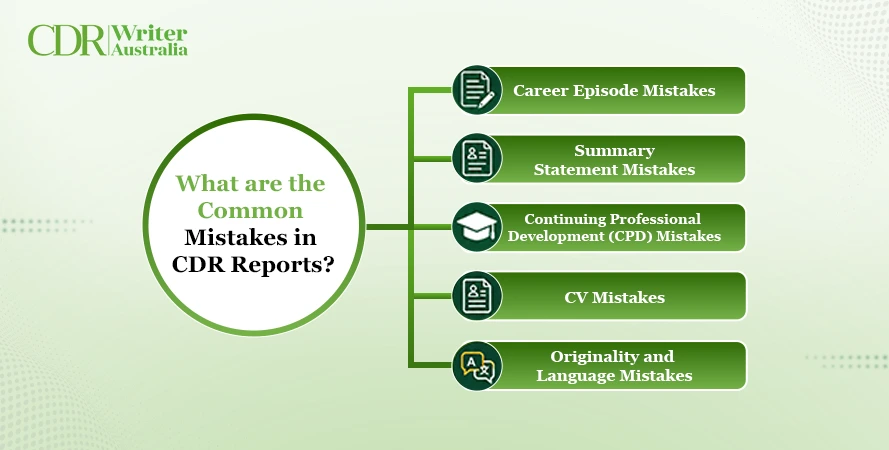
CDR report mistakes can appear in different parts of the document. Each section has a different purpose, so applicants must avoid errors in career episodes, summary statement, CPD, CV, and supporting documents.
Career episodes are the main part of a CDR because they explain your real engineering experience. Below are the common mistakes applicants make in career episodes.
-
Writing About the Project Than Your Role
Many applicants focus too much on the company, project background, or team activities instead of their individual contribution. Since Engineers Australia assesses your competencies, your career episode should clearly explain your engineering tasks, decisions, challenges, and achievements.
-
Using Unclear Technical Explanations
Many engineers fail to provide enough technical details in their career episodes. You should clearly explain the engineering methods, calculations, standards, software tools, and problem-solving approaches you used. Without clear technical explanations, assessors may find it difficult to evaluate your engineering competencies and expertise.
-
Not Showing Personal Contribution
Using terms like we or our team too often can make your role unclear. EA assesses your individual competencies, so your career episode should focus on your personal contributions. Use statements such as I designed, I analysed, I developed, or I implemented to clearly explain your responsibilities and achievements within the project.
-
Adding Generic Duties Only
Simply listing daily tasks does not prove competency. Your career episode should include real problems, actions, technical decisions, and measurable results from your engineering work.
-
Ignoring Proper Career Episode Structure
A career episode must follow the structure recommended by EA, including an introduction, background, personal engineering activity, and summary. Ignoring this structure can make your report difficult to read and may prevent assessors from clearly understanding your engineering competencies and contributions.
Summary statement maps your career episodes to the competency elements required by Engineers Australia. Errors in this section can make it difficult for assessors to verify your competencies, even if your career episodes are well written. Below are some of the most common summary statement mistakes applicants should avoid.
-
Wrong Paragraph Mapping
Many applicants link competency elements to the wrong career episode paragraphs. This makes it difficult for assessors to verify your claims and understand your competency evidence.
-
Repeating the Same Paragraph Often
Using one paragraph for too many competency elements can make the mapping look weak. Each competency should be supported by the most relevant and specific evidence.
-
Missing Competency Elements
Some applicants fail to address all required competency indicators. Missing elements can weaken the report and may lead to further assessment concerns.
-
Using Vague Competency References
A summary statement should not only mention paragraph numbers. It should clearly guide assessors to the sections that prove your engineering knowledge, skills, and professional ability.
The CPD section demonstrates your commitment to maintaining and improving your engineering knowledge and skills. Errors in this section can affect the completeness and professionalism of your CDR submission. Below are some of the most common CPD mistakes applicants should avoid.
-
Adding Incomplete CPD Details
A CPD list should include proper activity names, dates, duration, provider details, and learning outcomes where needed. Incomplete entries can make your professional development record look weak.
-
Including Irrelevant Activities
Unrelated training, general events, or non-engineering activities may not support your application strongly. CPD should show continuous learning related to your engineering field.
-
Using Outdated Learning Records
Relying only on old activities can make your professional development look inactive. Include recent courses, seminars, workshops, technical reading, and professional learning where possible.
-
Not Showing Professional Growth
CPD should reflect how you improved your technical knowledge, industry awareness, software skills, safety understanding, or engineering practice over time.
Your CV provides supporting evidence for the qualifications, employment history, and engineering experience presented in your CDR. Inaccurate, incomplete, or inconsistent information can raise concerns during the assessment process. Here are some of the most common CV mistakes applicants should avoid.
-
Inconsistent Employment Dates
Your CV dates must match your career episodes, reference letters, and employment documents. Different dates can create confusion and reduce trust in your application.
-
Unclear Job Titles and Roles
A vague job title or poorly explained role can weaken your profile. Your CV should clearly show your engineering position, responsibilities, and career progression.
-
Poor Formatting and Structure
An unorganised CV makes it harder for assessors to review your background. Use clear sections for education, employment, projects, technical skills, and professional development.
Supporting documents provide evidence to support the information presented in your CDR application. Errors such as missing documents, uncertified copies, poor-quality scans, incorrect translations, or inconsistencies across documents can create issues during the assessment process. Below are some of the most common supporting document mistakes applicants should avoid.
-
Missing Required Documents
Missing academic records, employment evidence, identity documents, or English test results can delay the assessment. Your supporting documents should be complete before submission.
-
Submitting Unclear or Poor-Quality Files
Blurry scans, cropped pages, or unreadable documents can create assessment issues. Every document should be clear, complete, and easy to verify.
-
Providing Mismatched Information
Your supporting documents should match the details in your CDR, CV, and application form. Different names, dates, job titles, or project details can raise concerns.
-
Not Adding Proper Employment Evidence
Employment references should clearly confirm your role, duties, duration, and organisation details. Weak or incomplete references may not support your claimed experience properly.
Engineers Australia expects every CDR to be original, authentic, and written in clear professional language. Issues such as plagiarism, excessive use of templates, grammatical errors, and unclear writing can reduce the quality of your report. Here are some of the most common originality and language mistakes applicants should avoid.
- Copying From Online Samples
-
Using AI or Template-Style Content Without Review
Using AI-generated or template-based content without proper customisation can make your CDR appear generic. Your report should include specific project details, technical decisions, and personal contributions that reflect your actual engineering experience.
-
Poor Grammar and Sentence Flow
Grammar mistakes, long sentences, and unclear wording can affect readability. Clear language helps assessors understand your engineering work without confusion.
Using content from online samples, templates, or previously submitted CDRs is one of the most common mistakes applicants make. EA requires all career episodes and supporting sections to be original and based on your own engineering experience. Any form of copied content can raise plagiarism concerns and negatively impact your assessment outcome.
Need Help Checking Your CDR Before Submission?
Get your CDR report reviewed for structure, technical clarity, Summary Statement mapping, grammar, and Engineers Australia compliance.
Contact usHow to Avoid Commom CDR Report Mistakes?
You can avoid common CDR report mistakes by writing original career episodes, adding clear technical details, mapping competencies correctly, and checking all documents before submission.
1. Follow the Correct CDR Format
Use the proper structure for career episodes, summary statement, CPD, CV, and supporting documents. A clear format helps assessors review your application easily and understand where each piece of information belongs.
2. Focus on Your Own Engineering Role
Clearly explain your individual contribution in each Career Episode. Focus on the tasks you performed, the decisions you made, and the results you achieved. Use "I" statements to highlight your engineering competencies and personal responsibilities.
3. Add Strong Technical Details
Include relevant engineering methods, tools, calculations, standards, and problem-solving approaches in your career episodes. Clear technical details help assessors understand how you applied engineering knowledge and demonstrate your competencies effectively.
4. Map competencies correctly
Check that each summary statement element links to the right paragraph in your career episodes. Proper mapping helps assessors find your competency evidence without confusion.
5. Keep all Information Consistent
Use the proper structure for career episodes, summary statement, CPD, CV, and supporting documents. A clear format helps assessors review your application easily and understand where each piece of information belongs.
6. Avoid Copied or Generic Content
Write your CDR in your own words and base it on your real engineering experience. Copied content, sample-based writing, or template-style explanations can weaken your application.
7. Review Before Submission
Carefully review your CDR before submission to identify grammar, formatting, structure, and content issues. A final review helps ensure your report is accurate, complete, and aligned with Engineers Australia requirements.
Also Read: CDR Report Writing Guidelines by Engineers Australia
Key Takeaways
Frequently Asked Questions
Yes, copying CDR samples is a serious mistake because Engineers Australia expects original content based on your own engineering experience. Samples should only be used to understand format and structure.
Yes, If you have used somebody else’s content (for definitions, principles or laws), you must provide in-text citations and a reference list.
Using the wrong ANZSCO code can affect your CDR because your report must match the skills, duties, and competency expectations of the nominated occupation. You should review the correct occupation carefully and update your career episodes, CV, and summary statement to align with the right ANZSCO code before submission.
Yes, excluding in-text citations and reference lists in a CDR is considered a mistake when you use external sources, standards, codes, manuals, images, or technical references. Proper citations help support your work, demonstrate professional integrity, and reduce the risk of plagiarism or originality concerns.
A CDR report full of mistakes can cause assessment delays, extra document requests, or rejection. It can also weaken your credibility if your career episodes, competency mapping, or supporting evidence are unclear or inconsistent.


