
How to Create an ACS RPL Report on Your Own | Complete Guide
13 minute read
Publish date: 2026/04/30
If you plan to apply for an Australian Computer Society (ACS) skills assessment through the Recognition of Prior Learning (RPL) pathway, writing the report on your own can feel challenging. Many applicants know their ICT work well but find it difficult to present their experience in the format ACS requires.
The main challenge is usually choosing suitable projects, explaining your exact role clearly, and linking your work experience to ACS knowledge areas.
In this blog, you will learn how to write an ACS RPL report on your own, structure each section correctly, avoid common mistakes, and prepare a stronger submission. Let’s get started!
What Is an ACS RPL Report?
An ACS RPL report is a Recognition of Prior Learning document that helps applicants prove their skills and knowledge through professional work experience instead of relying only on formal qualifications. The Australian Computer Society (ACS) uses the report to assess ICT applicants for migration skills assessments.
Applicants usually prepare the ACS RPL report when their degree is in a different field or does not closely match the ICT occupation they plan to nominate. Generally, RPL pathway is also used after gaining strong IT experience through years of hands-on work without a formal university qualification. Skilled migration visas that require an ACS skills assessment often rely on this report.
The report usually includes personal details, qualification history, employment records, key knowledge areas, and two project reports that explain technical responsibilities, tools used, and practical contributions.
Also Read: Why is Australia the Right destination for ICT professionals?
7 Steps to Write ACS RPL Report on Your Own
Step 1: Understand the Current ACS RPL Guidelines
Start by reading the latest ACS RPL form, question prompts, and submission instructions carefully. Knowing exactly what ACS asks in each section helps you plan stronger responses from the beginning.
Step 2: Choose the Right Topics for Section 1
Pick ICT knowledge topics that genuinely reflect the work you have performed and the skills you use in your role. Choosing familiar subjects makes it easier to provide clear and believable answers.
Step 3: Select Strong Topics for Core ICT Knowledge
Use core ICT areas that connect directly with the platforms, databases, networks, software, or systems you have worked with professionally. Relevant topic selection helps show practical industry knowledge rather than theory alone.
Step 4: Pick Two Suitable ICT Projects for Section 2
Select two projects where you solved real problems, handled technical responsibility, or delivered measurable results. Projects with clear personal involvement usually create stronger RPL evidence.
Step 5: Gather Accurate Project Details
After selecting the ACS RPL project reports that best describe your competence and skills, you need to provide the following project details.
- Client’s Company Name
- Legal Name of Entity
- Business Address
- Street Address
- Suburb State
- Postcode Country
- Contact Numbers (Telephone, Web address, Email Address)
- Nature of the project
- Location of the project
- Name of your employer
- Start date
- End date
Step 6: Clearly Explain Your Roles and Responsibilities
Show what you personally built, configured, analysed, tested, supported, or improved during each project. ACS wants to understand your contribution, not a general summary of the whole team.
Step 7: Review, Edit, and Finalise the Report
Read the full report again to fix weak wording, date mismatches, grammar issues, and repeated content. A polished final version makes your experience easier for ACS to assess.
Also Read: Employment Reference Letter for ACS RPL reports
What Are the Best Projects to Choose for an ACS RPL Report?
The best projects for an ACS RPL report solve real ICT problems, include meaningful technical responsibilities, and deliver clear results. In addition, use relevant tec highlight your personal contribution, and meet the ACS timeframe requirements.
1. Solved Real ICT Problems:
Projects that resolved software bugs, improved system performance, reduced manual work, fixed network issues, strengthened security, or solved business process problems through technology work well.
2. Handled Core Technical Responsibilities:
Projects involving coding, system design, database development, testing, server administration, cloud deployment, business analysis, technical support, or solution implementation provide stronger evidence.
3. Delivered Measurable Results:
Projects that achieved faster processing time, reduced downtime, cost savings, higher security, improved user experience, or successful system rollout add more value.
4. Used Technologies Relevant to Your Occupation:
Projects using tools connected to your nominated occupation, such as Java, Python, SQL, AWS, Azure, Cisco, Linux, SAP, Power BI, or cybersecurity platforms, help show alignment.
5. Allowed Clear Personal Explanation:
Projects where you can explain your responsibilities, technical decisions, challenges faced, and final outcomes clearly create a more credible report.
6. Met ACS Project Timeframe Requirements:
Recent projects that meet the current ACS recency rules help show that your ICT knowledge and hands-on experience remain current.
What ACS RPL Writing Tips Can Improve Your Report?
Good ACS RPL writing uses clear language and shows the work you personally completed in each role. It also keeps job details accurate, explains technical tasks with real results, uses original content, and presents every section with clean grammar and structure.
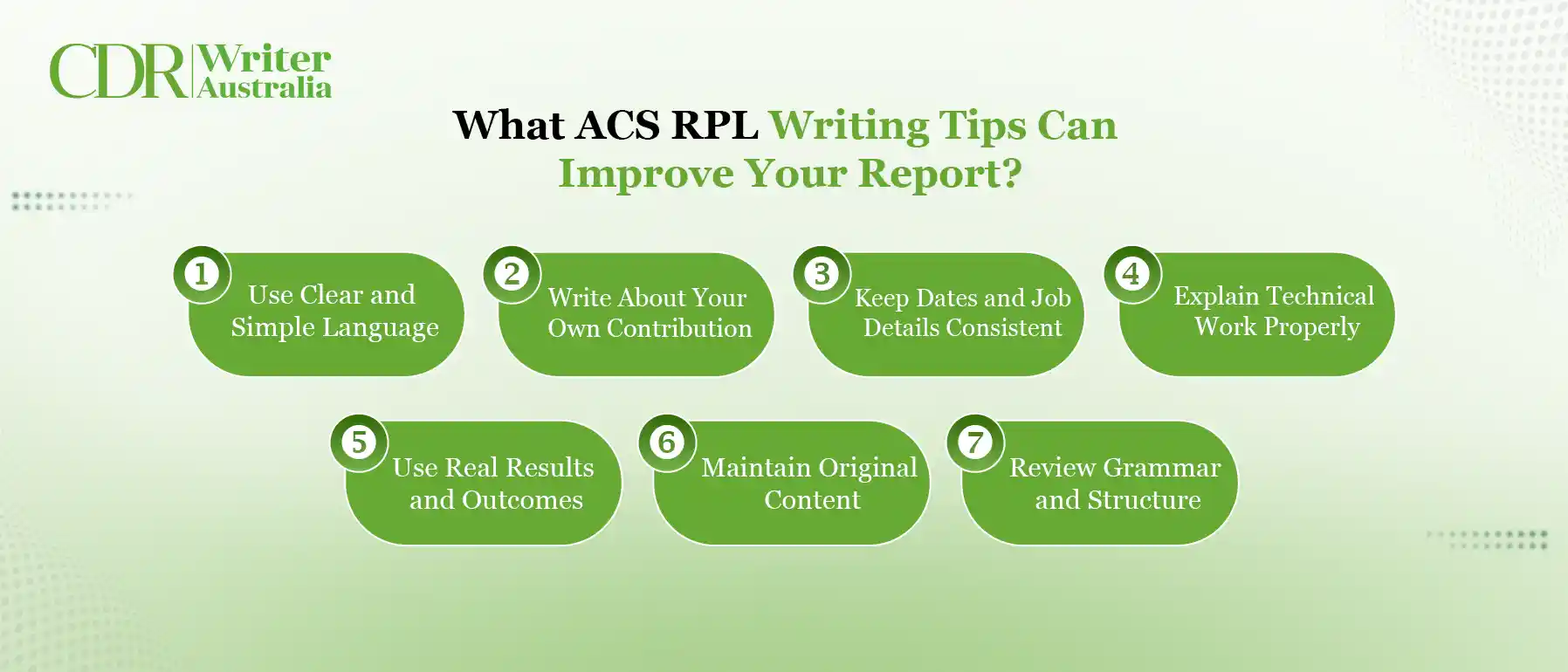
- Use Clear and Simple Language:
Clear writing helps ACS assessors understand your experience quickly. Short sentences, direct wording, and practical explanations usually leave a stronger impression than overly complex language.
- Write About Your Own Contribution:
ACS wants to know what you personally handled in each project. Personal responsibilities, technical decisions, and direct involvement carry far more value than broad team summaries.
- Keep Dates and Job Details Consistent:
Matching employment dates, job titles, employer names, and project timelines across the RPL report, CV, and application records builds trust and avoids confusion.
- Explain Technical Work Properly:
Strong reports explain the systems you used, tools you worked with, methods you followed, problems you handled, and solutions you delivered in practical language.
- Use Real Results and Outcomes:
Good project examples show measurable improvements such as faster processing, lower downtime, stronger security, cost savings, or smoother day-to-day operations.
- Maintain Original Content:
ACS expects authentic writing based on your real experience. Natural wording and accurate project detail make the report feel more genuine and reliable.
- Review Grammar and Structure:
Correct grammar, clean formatting, and organised sections make the report easier to read and help your experience stand out clearly.
Also Read: Complete Document Checklist for ACS Skill Assessment
How ACS Checks Originality in an RPL Report?
ACS checks originality in an RPL report by reviewing whether the content reflects your real work experience, writing style, and project involvement. Each section should present your own experience rather than copied samples or reused material.
Report content may be compared with previously submitted reports, online samples, and duplicated wording taken from public sources.
Clear explanations of the tasks you personally completed, decisions you made, and responsibilities you handled in each project usually create a stronger impression.
Project dates, job titles, employer details, and responsibilities may be compared with the information shown in your CV and application records.
The tools, systems, methods, and responsibilities described should match genuine ICT work experience and realistic workplace tasks.
Repeated phrases, broad project summaries, and unnatural wording can make the report feel weak and less convincing.
Specific project details, natural explanations, and realistic examples taken from actual work experience usually build stronger credibility.
Common Mistakes to Avoid When Writing an ACS RPL Report
A strong ACS RPL report can quickly lose impact when copied content, weak projects, or team-based descriptions replace clear personal experience. Inconsistent job details and vague technical explanations can also create doubts and reduce the strength of your application.
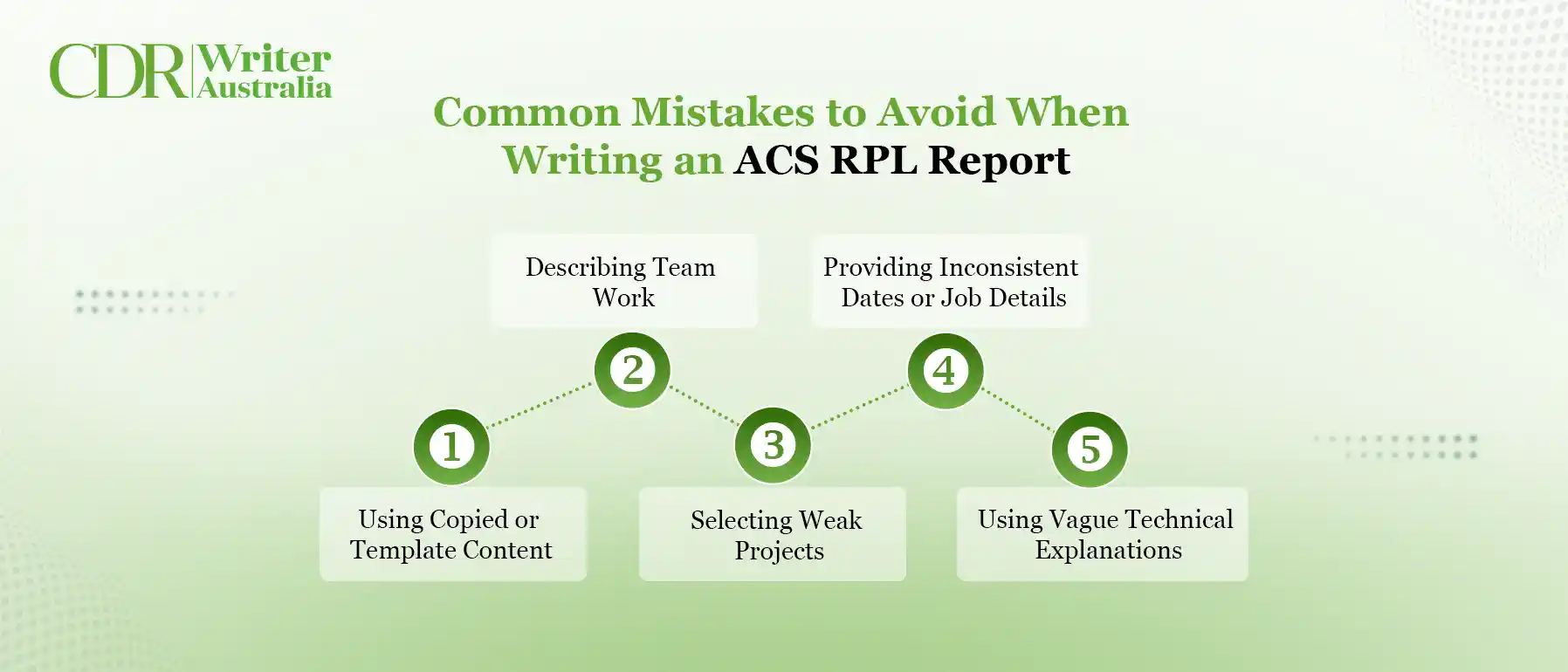
- Using Copied or Template Content:
Copied samples, reused wording, or borrowed material can raise originality concerns and weaken the report.
- Describing Team Work:
Team summaries often hide your actual roles and duties. ACS wants to see the tasks you completed, decisions you made, and responsibilities you handled.
- Selecting Weak Projects:
Projects with limited technical work, unclear involvement, or no clear results often fail to show strong ICT capability.
- Providing Inconsistent Dates or Job Details:
Different dates, changing job titles, or mismatched employer information can create doubts and slow the assessment.
- Using Vague Technical Explanations:
Generic statements without systems used, tools applied, methods followed, or actions taken make your experience harder to understand and assess.
Key Takeaways
Frequently Asked Questions
ACS does not set a fixed word limit for the RPL report. Most successful reports focus on clear answers, relevant detail, and direct explanations instead of unnecessary length.
ACS usually requires identity documents, qualification records, CV, and employment evidence for skills assessment. Passport copies, degree certificates, transcripts, reference letters, and payslips are commonly requested.
Yes, you can use industry-specific terms in the ACS RPL report. Terms such as frameworks, tools, databases, or platforms can strengthen your report when you explain them clearly.
Yes, you can include diagrams in the ACS RPL project report. Flowcharts, system architecture diagrams, or process maps can help explain technical work more clearly.
Yes, you can include freelance or self-employed experience in the ACS RPL report. Invoices, contracts, client communication, and project evidence usually help support self-employed claims.


