
Migration Skill Assessment (MSA) Booklet Engineers Australia Guide 2026
12 minute read
Publish date: 2026/06/18
Planning to migrate to Australia as an engineer can be exciting; however, the Migration Skills Assessment (MSA) process can often feel overwhelming. Many applicants are unsure about the correct assessment pathway, required documents, competency requirements, and application procedures set by Engineers Australia.
To help simplify this process, the MSA Engineers Australia booklet provides a clear and comprehensive overview of the latest assessment requirements, eligibility criteria, and application procedures. Without a proper understanding of these updated requirements, even small mistakes can lead to delays, additional document requests, or an unsuccessful assessment outcome.
In this guide, you will learn how to prepare a complete MSA application, covering the online application process, occupational categories, pathways, documents, English requirements, fees, and common mistakes.
What is the MSA Booklet for Engineers Australia?
The Engineers Australia Migration Skills Assessment (MSA) Booklet is the official guide that explains how engineers can have their qualifications assessed for skilled migration to Australia.
The MSA Booklet is published by Engineers Australia and outlines the key rules, procedures, documents, and requirements for submitting a Migration Skills Assessment application. The booklet helps applicants understand the right assessment pathway, English requirements, CDR documents, skilled employment evidence, and the application process.
Who Should Read the Engineers Australia MSA Guide?
The Engineers Australia MSA guide should be read by engineering applicants who want to migrate to Australia through a skilled visa pathway. It is useful for overseas-qualified engineers, CDR applicants, accredited qualification holders, Engineering Managers, migration agents, and first-time applicants who need to prepare a complete skills assessment application.
How to Apply for Engineers Australia MSA Online?
You can apply for the Engineers Australia Migration Skills Assessment online through the EA portal. Before you start, check your qualification, choose the right assessment pathway, prepare your documents, and submit a complete application.
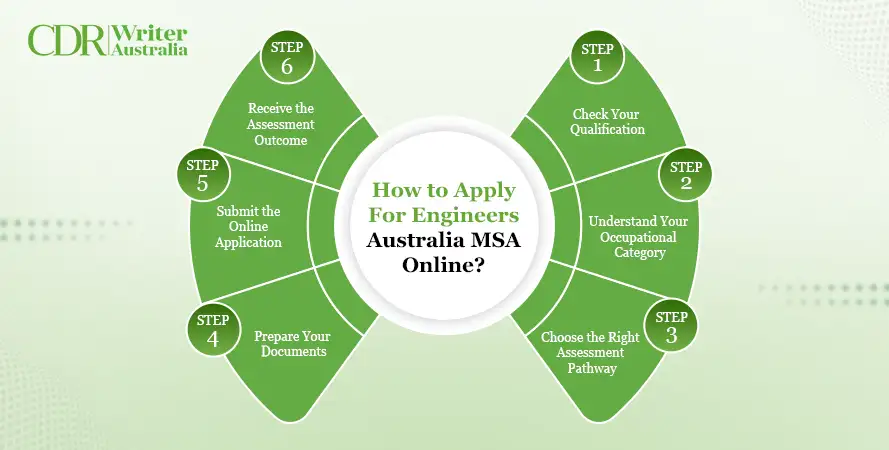
First, check your engineering qualification before choosing an assessment pathway. Confirm whether your qualification is Australian, internationally accredited, accord-recognised, or non-accredited. Also, review your country of study, qualification level, graduation year, and accreditation status. These details help you choose the correct Engineers Australia MSA pathway.
Identify the occupational category that matches your engineering education and work experience. Engineers Australia assesses applicants under four categories: Professional Engineer, Engineering Technologist, Engineering Associate, and Engineering Manager. Choosing the right category helps align your application with the correct competency standard.
After checking your qualification and occupational category, select the most suitable assessment pathway. You may apply through the Australian Qualifications, Washington Accord, Sydney Accord, Dublin Accord, or CDR pathway. If your qualification is not accredited, or your nominated occupation differs from your degree title, you may need the CDR pathway.
Now, prepare all documents required for your selected pathway. These may include your passport, photograph, CV, academic certificate, transcript, CPD statement and more.
Create an account in the Engineers Australia portal and start your Migration Skills Assessment application. Select your assessment pathway, enter the required details, upload your documents, review every section, and submit the application. After submission, you should receive an email confirmation from EA.
Once Engineers Australia reviews your application, you will receive the assessment outcome by email. If your application is successful, you will receive a Migration Skills Assessment outcome letter for migration purposes. You can verify the outcome letter through the EA portal and check visa validity rules with the Department of Home Affairs.
Engineering Occupational Categories in the Engineers Australia MSA Booklet
Engineers Australia lists three main occupational categories: Professional Engineer, Engineering Technologist, and Engineering Associate. For migration skills assessment, Engineers Australia also includes an Engineering Manager as a separate assessment category.
1. Professional Engineer
A professional engineer usually holds a four-year professional engineering degree. This category suits applicants who work on complete engineering systems, complex technical problems, design decisions, leadership tasks, and project-level responsibilities.
Professional Engineers often deal with broad engineering problems. Applicants in this category usually apply for roles that require advanced engineering judgment and independent decision-making.
2. Engineering Technologist
An engineering technologist typically holds a three-year engineering technology degree. This category is suitable for applicants who use engineering knowledge to apply, improve, and manage technology in engineering projects and systems.
Their work often involves improving existing systems, selecting suitable technologies, solving technical problems, and supporting engineering projects. This category is best suited to applicants whose qualifications and work experience focus on the practical application of engineering technology.
3. Engineering Associate
Applicants in the engineering associate category are typically qualified through a two-year advanced diploma or associate degree in engineering. Their role focuses on providing technical support and assisting with the implementation of engineering solutions.
An engineering associate may be involved in activities such as preparing technical drawings, conducting tests and inspections, and maintaining engineering equipment and systems. This category is ideal for individuals with strong practical skills and experience working within established engineering frameworks and procedures.
4. Engineering Manager
The engineering manager category is available for migration skills assessment purposes and is suitable for applicants with an engineering qualification and relevant management experience. These professionals are responsible for planning, directing, and overseeing engineering operations, projects, policies, and technical teams.
Applicants for this category generally apply through the Competency Demonstration Report (CDR) pathway and must provide evidence of skilled employment to demonstrate their engineering management responsibilities and experience.
What are the Migration Skills Assessment (MSA) Pathways for Engineers Australia?
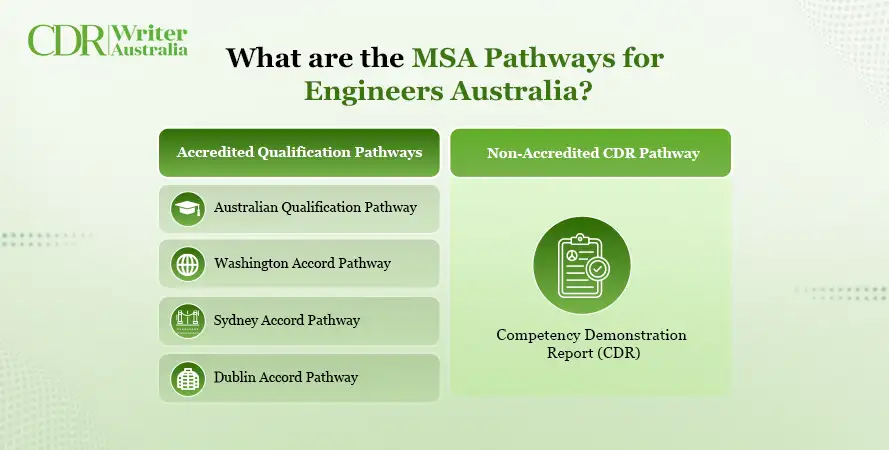
Engineers Australia migration skills assessment pathways can be divided into two main categories: accredited qualification pathways and the non-accredited CDR pathway. However, the MSA pathway for EA depends on your qualification, accreditation status, and nominated occupation.
1. Accredited Qualification Pathways
Accredited qualification pathways are for applicants who hold engineering qualifications recognised by Engineers Australia or international engineering accords. These pathways are suitable when your qualification is accredited and matches your nominated engineering occupation. In most cases, you do not need to submit a Competency Demonstration Report under these pathways.
The main accredited MSA pathways include:
A. Australian Qualification Pathway
The Australian Qualification pathway is for applicants with an Australian engineering qualification accredited by EA. This pathway is suitable when your qualification title or major matches your nominated engineering occupation.
B. Washington Accord Pathway
The Washington Accord Pathway is for engineers who have completed an accredited engineering degree from countries that are part of the Washington Accord. It is mainly for professional engineer-level qualifications.
This pathway allows Engineers Australia to recognise that your qualification meets international engineering education standards, similar to those in Australia. It may also apply to certain recognised qualifications, such as engineering degrees from France (CTI accredited), a Spanish master of industrial engineering with CGCOI registration, or a Spanish master of civil engineering with CICCP registration evidence.
C. Sydney Accord Pathway
The Sydney Accord pathway is for applicants with accredited engineering technologist qualifications from Sydney Accord signatory countries. This pathway is suitable for applicants whose education aligns with the engineering technologist occupational category.
D. Dublin Accord Pathway
The Dublin Accord pathway is for applicants with accredited engineering associate qualifications from Dublin Accord signatory countries. This pathway usually applies to engineering associate-level qualifications.
2. Non-Accredited CDR Pathway
The non-accredited pathway is for applicants whose engineering qualification is not accredited by Engineers Australia or an international engineering accreditation.
This pathway also applies when applicants have an accredited qualification but want an assessment in a different engineering occupation. Engineers Australia uses this pathway to check whether the applicant’s knowledge, skills, and experience match the nominated occupation. The main non-accredited MSA pathways include:
A. Competency Demonstration Report (CDR)
The CDR is the main requirement under the Non-Accredited Pathway. A CDR helps applicants prove their engineering competency through real project work, study experience, or professional practice. Engineering Manager applicants also use this pathway and must provide relevant skilled employment evidence.
A complete CDR usually includes Continuing Professional Development (CPD) , three career episodes, and a summary statement. The career episodes explain how the applicant applied engineering knowledge in specific tasks or projects. The summary statement links those career episodes to Engineers Australia’s competency elements.
Documents Required for Engineers Australia MSA
The documents required for the Engineers Australia Migration Skills Assessment (MSA) include a valid passport, academic qualifications, CV/resume, English test results, and employment evidence (if applicable). However, the exact document requirements may vary depending on the assessment pathway you choose.
Applicants must prepare clear, high-resolution colour scans of their original documents before lodging the online MSA application. If any document is not in English, both the original document and an authorised English translation must be provided.
1. Documents Required for the CDR Pathway
The CDR pathway requires more detailed documentation because Engineers Australia assesses both academic knowledge and practical engineering competency. Applicants must provide evidence of identity, qualifications, English proficiency, engineering knowledge, and workplace experience.
The main documents required for the CDR pathway include:
- Valid passport bio data page
- Change of name document, if applicable
- Recent passport-sized colour photograph
- Detailed CV
- English language evidence, unless exempt
- Degree certificate or testamur
- Academic transcripts
- Licensure or registration certificate, if applicable
- Continuing Professional Development statement
- Three Career Episodes
- Summary Statement
2. Documents Required for Accredited Pathways
Applicants using an accredited pathway usually have fewer document requirements because their qualification is already recognised by Engineers Australia or an international accord.
The main accredited pathway documents include:
- Valid passport bio data page
- Change of name document, if applicable
- Recent passport-sized colour photograph
- Detailed CV
- English language evidence, unless exempt
- Qualification certificate or degree certificate
- Academic transcripts
- Official English translations, if applicable
3. Documents for Relevant Skilled Employment Assessment
Applicants who want Engineers Australia to assess skilled employment must provide extra employment evidence. This assessment is mandatory for Engineering Manager applicants.These documents help EA verify the applicant’s claimed employment period, role, engineering duties, and relevance to the nominated occupation.
The main skilled employment documents include:
- Employment reference letter on company letterhead
- Employment type, such as full-time, part-time, or casual
- Pay rate or salary details
- Job title or position held
- Employment start and end dates
- Name and position of the person issuing the letter
- Company stamp, if applicable
- Letter issue date
- At least five main engineering duties
- Secondary evidence, such as tax records, payslips, government records, or superannuation records
4. Documents for Overseas PhD Assessment
Applicants requesting an overseas engineering PhD assessment must provide extra academic and research evidence. These documents help Engineers Australia understand the engineering focus, research depth, and academic contribution of the overseas PhD.
The main overseas PhD assessment documents include:
- PhD qualification evidence
- Thesis abstract
- List of doctoral examiners
- List of publications completed during or after the doctoral program
- Other research evidence, if requested by Engineers Australia
Want to create an Engineers Australia-compliant CV? Read our blog: How to Write a Perfect CV for Engineers Australia?
English Language Requirements for Engineers Australia MSA
To apply for the Engineers Australia MSA, applicants must meet the required English language standard. This helps EA confirm that they can communicate effectively in listening, reading, writing, and speaking within a professional engineering environment.
Applicants must upload valid English test results during the online application. They also need to provide the test report number, registration number, or score report code so EA can verify the result.
Engineers Australia accepts the following English language tests:
- IELTS Academic or General
- TOEFL iBT
- PTE Academic
- CLANGUAGECERT Academic
- Michigan English Test
- CELPIP General
Minimum English Scores for Tests
| Test | Listening | Reading | Writing | Speaking |
|---|---|---|---|---|
| IELTS | 6 | 6 | 6 | 6 |
| TOEFL iBT | 16 | 16 | 19 | 19 |
| PTE Academic | 47 | 48 | 51 | 54 |
| Cambridge C1 Advanced | 169 | 169 | 169 | 169 |
| LANGUAGECERT | 57 | 60 | 64 | 70 |
| Michigan English Test (MET) | 56 | 55 | 57 | 48 |
| CELPIP General | 7 | 7 | 7 | 7 |
Notes:
- Tests must be taken within 3 years before MSA application and must remain valid and verifiable.
- Exemption may apply for 2+ years study in Australia at a CRICOS-registered institution and AQF level 6 or above.
- Citizens of the UK, USA, Canada, New Zealand, or Ireland may also be exempt, but additional evidence may still be requested.
Engineers Australia MSA Fees and Payment Cost
Engineers Australia MSA fees depend on the assessment pathway you choose. The cost is different for Australian qualification assessment, International Accord assessment, CDR assessment, and extra services like fast-track or skilled employment assessment.
| MSA Fee Category | Starting Fee Excl. GST | Starting Fee Incl. GST |
|---|---|---|
| Australian engineering qualification assessment | AUD 305 | AUD 335.50 |
| Washington, Sydney, or Dublin Accord assessment | AUD 490 | AUD 539 |
| Competency Demonstration Report assessment | AUD 910 | AUD 1001 |
| Fast-track assessment fee | AUD 350 | AUD 385 |
| Relevant skilled employment assessment | AUD 470 | AUD 517 |
Need Help With Your Engineers Australia MSA Application
Get expert support to review your MSA pathway, ANZSCO code, CDR, Career Episodes, Summary Statement, CPD, English requirements, and documents before submission.
Contact our MSA experts today.Common Mistakes to Avoid in MSA Applications
The common mistakes to avoid in MSA applications include submitting incomplete or incorrect documents, choosing the wrong assessment pathway, and providing unclear or low-quality scanned copies.
Selecting an incorrect pathway can lead to unnecessary complications or even an unsuccessful assessment outcome. It can also affect the required document checklist and delay the overall application process.
Missing passport details, academic transcripts, English evidence, or employment proof can delay the assessment. Applicants should check all required documents before lodging the application.
Blurry, cropped, or low-resolution scans make it difficult for Engineers Australia to verify information and may lead to additional document requests.
English test results must be valid and verifiable during assessment. Applicants should confirm their test date and report details before submission.
CDR applicants should write Career Episodes that show their own engineering work, decisions, and problem-solving ability. Generic project descriptions may not prove competency.
The Summary Statement must link competency elements to specific career episode paragraphs. Incorrect mapping can make the assessment harder.
Employment letters should clearly mention job title, dates, work type, salary, and engineering duties. Weak or vague employment proof may affect skilled employment assessment.
Names, dates, qualification details, and employment records should match across all documents. Inconsistent or misleading details can affect the final outcome.
Key Takeaways
Table of Content
- MSA Booklet for Engineers Australia?
- How to Apply for Engineers Australia MSA Online?
- Engineering Occupational Categories
- Migration Skills Assessment (MSA) Pathways
- Documents Required for Engineers Australia MSA
- English Language Requirements for MSA
- Engineers Australia MSA Fees and Payment Cost
- Key Takeaways
- FAQs
Frequently Asked Questions
No, you should not use AI to write your full CDR. Your CDR must show your own engineering work, decisions, and personal contribution. The technical content and project details must come from your own experience.
Submitting AI-written, copied, false, or misleading content can lead to rejection, a 12, 24, or 36-month ban, and reporting to the Department of Home Affairs.
Engineers Australia MSA applications generally take about 15 weeks to be assigned to an assessor. Fast-track applications can be assigned faster, usually within 20 business days.
However, this does not guarantee the final outcome date. The total time depends on your assessment pathway, document quality, and whether Engineers Australia asks for more information.
Yes, you can submit old work experience if it is relevant to your nominated engineering occupation. The experience should show your engineering duties, responsibilities, skills, and personal contribution.
You should also provide clear evidence, such as reference letters, payslips, contracts, or tax records. If the experience is too old, unclear, or unrelated, it may not strongly support your MSA application.
If your MSA application is incomplete, Engineers Australia may ask you to provide missing or unclear information. This can delay your assessment. In some cases, the application may receive an unsuitable outcome if the required evidence is not provided.