
KA02 Knowledge Assessment Guide for New Zealand Engineering Applicants
12 minute read
Publish date: 2026/05/05
In New Zealand’s competitive engineering field, a degree title may not always prove an applicant’s knowledge level. If Engineering New Zealand cannot confirm qualification equivalence through a credential check, the applicant may need KA02 to show technical knowledge more clearly.
To support the KA02 application, applicants need academic transcripts, course descriptors, a self-assessment statement, and work records. These documents help the assessing authority review the applicant’s study background and engineering experience.
In this guide, you will learn who needs KA02, what documents to prepare, how the assessment process works, and how to avoid mistakes that can delay the application.
What is KA02 Knowledge Assessment?
KA02 Knowledge Assessment is a technical check that shows whether an applicant’s engineering knowledge meets New Zealand’s required standard. Engineering New Zealand, the assessing authority, usually asks for KA02 when it cannot confirm the applicant’s qualification level through a credential check.
For Professional Engineer applicants, KA02 compares their engineering knowledge with the level expected from a Washington Accord-accredited degree. Applicants may need it for skilled migration, Chartered Member eligibility, or CPEng eligibility. In the assessment, they show what they studied, which projects they worked on, and how they used engineering knowledge in real work.
Who Needs a KA02 Knowledge Assessment?
Engineers need a KA02 Knowledge Assessment when Engineering New Zealand cannot confirm their qualification through a credential check. In this case, KA02 gives them a way to show their knowledge through course records, project evidence, work samples, and experience.
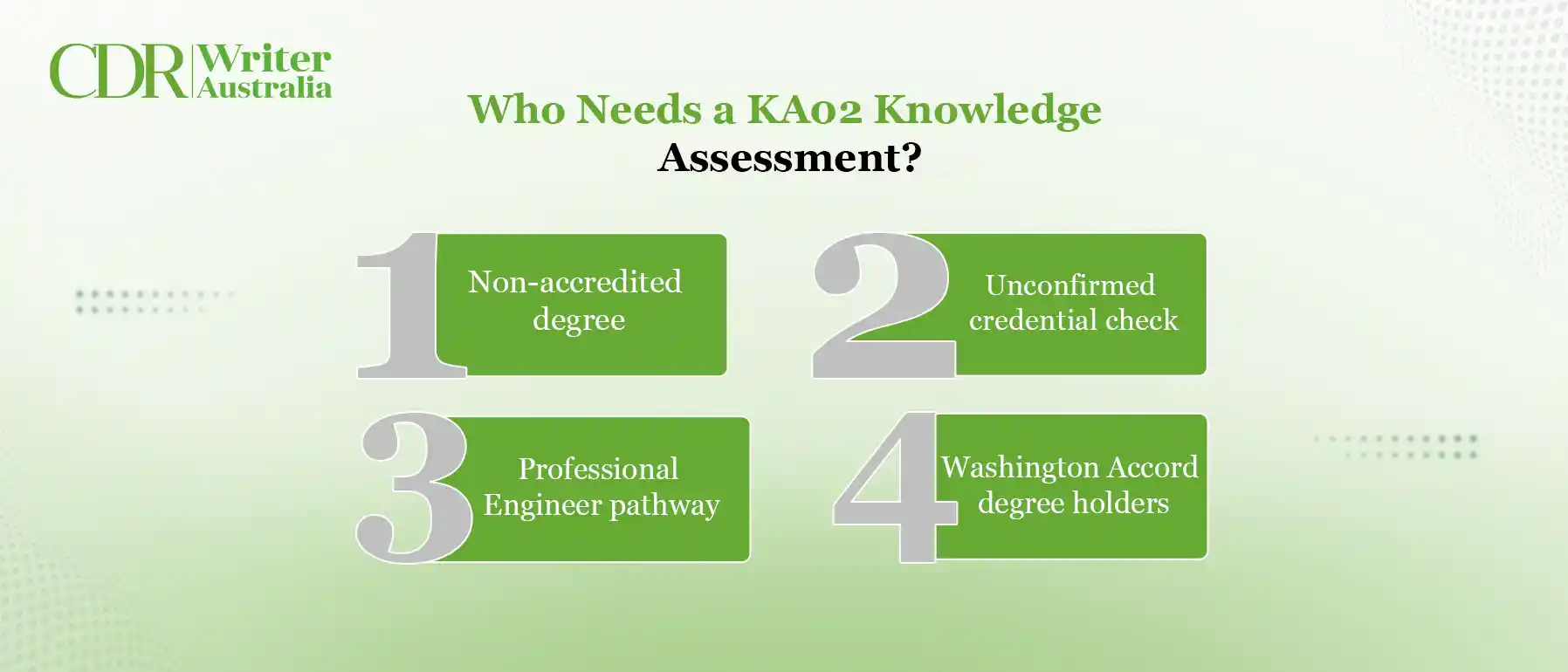
1. Non-accredited degree:
The engineering degree falls outside recognised Accord pathways, so the applicant must show that the course covered the required engineering knowledge areas.
2. Unconfirmed credential check:
Engineering New Zealand may direct the applicant to KA02 when transcripts, degree certificates, or course details do not prove the required qualification level.
3. Professional Engineer pathway:
Skilled migration, Chartered Member, or CPEng pathways may require proof that the applicant’s knowledge matches a Washington Accord-accredited qualification.
4. Washington Accord degree holders:
Engineers with a confirmed Washington Accord-accredited degree usually complete a credential check instead of KA02, which makes the academic review simpler.
What are the 8 Knowledge Assessment Elements?
The Knowledge Assessment elements cover the main areas applicants must show in a KA02 application. These areas include science, maths, engineering fundamentals, specialist knowledge, design process, engineering practice, social responsibility, and research-based learning.
1. Natural Sciences Knowledge:
Natural sciences knowledge shows how well the applicant understands the science used in engineering. It can include physics, chemistry, biology, geology, or other science subjects linked to the chosen engineering field.
Performance indicators:
- Show knowledge of scientific principles that explain natural systems and physical behaviour.
- Connect science subjects, such as physics or chemistry, with engineering problems.
- Use scientific methods, investigation, and problem-solving steps to explain technical work.
2. Mathematical Knowledge:
Mathematical knowledge shows how the applicant uses numbers, formulas, data, and calculations in engineering work. Engineering New Zealand treats this area carefully because work experience alone may not always prove mathematical depth.
Performance indicators:
- Use mathematics, statistics, and numerical methods to support engineering models.
- Explain the assumptions used in calculations, models, or technical analysis.
- Organise and analyse data to understand variation, patterns, or performance.
- Apply trigonometry, probability, calculus, and multivariable calculus to engineering problems.
- Show basic programming knowledge where computing supports technical work.
3. Engineering Fundamental Knowledge:
Engineering fundamental knowledge covers the core engineering principles behind the applicant’s discipline. It shows whether the applicant can use basic engineering theory to understand and solve technical problems.
Performance indicators:
- Explain core engineering concepts related to the selected discipline.
- Use engineering fundamentals to think through technical problems independently
- Show broad knowledge across engineering concepts, not only one narrow topic.
- Apply basic engineering principles to solve discipline-related problems.
4. Specialist Engineering Knowledge:
Specialist engineering knowledge shows deeper learning in a specific nominated occupation. It shows whether the applicant understands advanced topics, technical methods, and accepted practice areas within the discipline.
Performance indicators:
- Show enough depth to support work in a recognised engineering field.
- Explain specialist theories, principles, applications, and problem-solving methods.
- Apply specialist knowledge to solve complex engineering problems.
5. Design Process Knowledge:
Design process knowledge shows how the applicant develops engineering solutions.A strong work sample or academic project should show the full design process, not only the final result.
Performance indicators:
- Research and analyse information before starting the design.
- Study a system, situation, or problem to identify causes and effects.
- Build mathematical, physical, or conceptual models with clear assumptions.
- Use design methods, tools, and technical knowledge to develop a solution.
- Compare design options and explain why one option works better.
- Review constructability, manufacturing feasibility, or practical delivery issues.
- Show personal involvement in a major design task.
- Consider safety, reliability, ethics, cost, appearance, and social impact during design.
- Use suitable design methods to solve complex engineering problems.
6. Engineering Practice Knowledge:
Engineering practice knowledge shows how the applicant applies engineering knowledge in real work. It covers tools, materials, systems, communication, project control, and teamwork.
Performance indicators:
- Explain current issues that affect technical and professional engineering practice.
- Use tools or software to model, simulate, test, or predict engineering outcomes.
- Check results and explain the limits of tools, models, or software.
- Select materials, resources, or techniques based on project needs.
- Show knowledge of laboratory procedures and safety practices.
- Use systems, equipment, information technology, or specifications for engineering work.
- Write clear technical correspondence about a project, product, or process
- Prepare and deliver technical presentations with suitable support materials.
- Communicate with both technical and non-technical audiences
- Track project schedules, costs, or engineering resources.
- Work effectively as a team member or team leader.
7. Engineering in Society Knowledge:
Engineering in society knowledge shows how the applicant considers people, safety, ethics, risk, sustainability, and environmental effects. It connects engineering decisions with people, communities, and the environment.
Performance indicators:
- Follow ethical standards and professional conduct in engineering work.
- Make decisions that align with a relevant code of ethics.
- Apply health and safety practices in engineering activities.
- Use safe methods during laboratory, testing, or experimental work.
- Consider social, cultural, and environmental effects of engineering decisions.
- Show awareness of sustainable technologies and sustainable development.
- Identify risks caused by project limits, business limits, or technical trade-offs.
- Use risk management methods to check information, reliability, and safety.
- Understand quality management tools, systems, and processes.
8. Research-Based Knowledge:
Research-based knowledge shows how the applicant stays updated with technical learning and new engineering methods. It also shows how the applicant connects new research, technology, or methods with real engineering practice.
Performance indicators:
- Show advanced knowledge in at least one area of the engineering discipline.
- Explain how new developments connect with existing theory and practice.
- Describe recent progress in engineering research, science, or technology.
- Show ongoing learning through Continuing Professional Development (CPD), technical study, research, or professional development.
What are the KA02 Knowledge Assessment Pathways?
Engineering New Zealand offers two Knowledge Assessment pathways: Standard and Fast Tracked. The right option depends on whether the applicant needs a letter for Immigration New Zealand or regular assessment processing.
1. Standard Knowledge Assessment
The Standard Knowledge Assessment is the regular pathway for applicants who do not need a letter for urgent immigration use. Engineering New Zealand accepts this option for all applicants and usually completes the assessment in about 50 working days.
2. Fast Tracked Knowledge Assessment
The Fast Tracked Knowledge Assessment is for applicants who need a Knowledge Assessment letter for Immigration New Zealand. Engineering New Zealand usually completes the Fast Tracked Knowledge Assessment in about 25 working days. This option costs more because it gives priority processing to applicants who need a Knowledge Assessment letter for Immigration New Zealand.
| Pathway | Best For | Approx. Processing Time |
|---|---|---|
| Standard Knowledge Assessment | Applicants who do not need fast processing for immigration | 50 working days |
| Fast Tracked Knowledge Assessment | Applicants who need a Knowledge Assessment letter for Immigration New Zealand | 25 working days |
Also Read: Fast Track Skill Assessment Australia
What is the KA02 Assessment Application Process?
The KA02 process starts with a credential check and ends with Engineering New Zealand’s final decision. Between those steps, applicants prepare the documents that tell their story, including academic records, course details, self-assessment statements, work samples, and project evidence.
Stage 1: Complete the Credential Check
Start with the credential check. Engineering New Zealand reviews the qualification details and compares them with recognised engineering education standards. If the qualification does not meet the required benchmark through this check, the applicant can continue with the KA02 pathway.
Stage 2: Prepare the Evidence
Review the 8 Knowledge Assessment elements before preparing the application. Then gather documents, such as transcripts, course descriptors, academic projects, technical reports, work samples, CPD records, and an updated CV. The evidence should show what the applicant studied, what engineering work they completed, and how they used technical knowledge in practice.
Stage 3: Apply Through the Online Portal
Update the online profile and request the Knowledge Assessment. Upload the required documents, including academic transcripts, course descriptors, a CV with a recent photo, and a valid photo ID. If any academic document is not in English, include a certified English translation.
Stage 4: Complete the Self-Assessment Statements
Write a clear response for each Knowledge Assessment element. Refer to specific evidence, such as reports, drawings, calculations, presentations, course records, or work samples. Each response should show how the applicant’s study or work experience meets the required knowledge area.
Stage 5: Wait for Validation and Evaluation
After submission, Engineering New Zealand checks whether the application includes the required information. Once the file passes validation, an assessor reviews the evidence in detail. The assessor may ask for more information or invite the applicant to an interactive video meeting to explain qualifications, projects, and work samples.
Stage 6: Receive the Final Decision
Engineering New Zealand sends the final outcome by email. If the application meets the required standard, the applicant receives the assessment result. If some areas need stronger proof, the decision report explains which Knowledge Assessment elements require more evidence.
Also Read: ACS Skills Assessment: Eligibility, Fees & Visa Guide
What Happens During the Interactive Assessment?
The KA02 interactive assessment is a live video discussion with an assessor. During the meeting, the applicant may need to talk about their qualification, course background, project work, work samples, and self-assessment statements.
| Area | What It Means |
|---|---|
| Meeting format | The assessment usually happens through a video call and may take around 60 minutes. |
| Main purpose | The assessor checks whether the applicant understands the submitted evidence and can explain the engineering knowledge behind each document. |
| Topics discussed | The discussion may cover academic background, course content, project work, design choices, calculations, work samples, and technical problem-solving. |
| Applicant’s role | The applicant should explain their own work clearly, including what they planned, calculated, designed, tested, reviewed, or reported. |
| Documents to review | The applicant should go through transcripts, course descriptors, self-assessment statements, project records, and work samples before the meeting. |
| Language used | The meeting takes place in English, so the applicant should explain technical details in clear and simple words. |
What Happens After the KA02 Assessment Decision?
After the KA02 review, Engineering New Zealand sends the result by email. The result shows whether the applicant’s evidence meets the required knowledge standard. If some areas need stronger proof, the report points to the exact Knowledge Assessment elements that need more work.
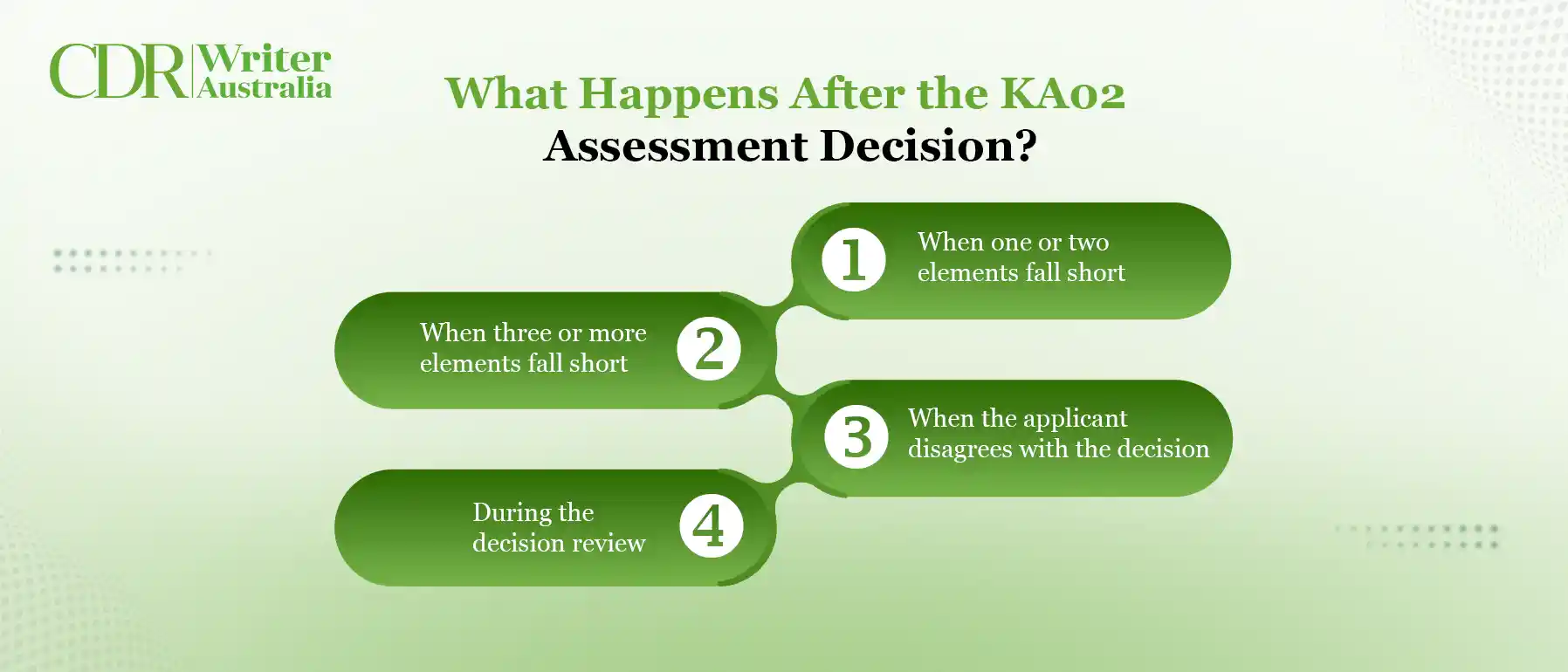
The applicant can submit evidence of bridging activities within 12 months. Engineering New Zealand may review the next Knowledge Assessment without an extra assessment fee when the gap covers only one or two elements.
The applicant can submit bridging evidence within 12 months, but Engineering New Zealand charges $500 excluding GST for the next Knowledge Assessment. This applies because the previous report found gaps across several knowledge areas.
The applicant can request a decision review within 4 weeks of receiving the result. The request must include the Decision Review Form, a cover letter explaining the issue, and a $600 review fee excluding GST.
Engineering New Zealand may assign a new assessor to review the decision. The applicant cannot add new evidence at this stage, and the review does not include another interactive interview. The review usually takes around 8 weeks.
Key Takeaways
Frequently Asked Questions
Yes, applicants can use confidential work documents if they remove private or restricted details first. This may include client names, company names, project costs, contract values, site addresses, employee names, signatures, internal codes, financial data, and commercially sensitive design details.
No, KA02 does not depend only on academic evidence, but also project records, work samples, technical reports, calculations, drawings, CPD records, and documents that show how they used engineering knowledge in real work.
Yes, applicants can include team projects if they clearly explain their own role. The evidence should show what they planned, calculated, designed, tested, reviewed, reported, or managed in the project.
No, CPD is not always required as the main evidence. Still, training, workshops, seminars, software learning, and technical reading can support the application by showing recent engineering learning.
No, someone else should not write the KA02 application for the applicant. KA02 checks the applicant’s own engineering knowledge. Every response should use the applicant’s own words and reflect their own work.


