
CDR Report Preparation Time: A Complete Timeline and Planning Guide
13 minute read
Publish date: 2026/07/21
You may be wondering, how long does it take to complete a CDR report? A week, a month, or even longer? The answer changes with your project records, writing readiness, and available time.
That uncertainty can feel frustrating, especially when your submission plans depend on the CDR preparation timeline. Missing details can force repeated revisions, date checks, and competency mapping changes.
In this guide, you will discover what shapes Competency Demonstration Report (CDR) preparation time and how to plan each stage with confidence.
How Long Does CDR Preparation Usually Take?
You may need several weeks to prepare your CDR, depending on how ready your project information is. A practical estimate is around two to four weeks.
This timeframe may cover planning, drafting, competency mapping, and final checks. Engineers Australia does not publish an official CDR preparation timeframe.
Your actual timeline may be shorter or longer based on your readiness. Therefore, use this estimate to plan your work rather than set a fixed deadline.
How Much Time Does Each CDR Section Require?
Each CDR section requires a different preparation period. Your Career Episodes may take weeks, while your Summary Statement and Continuing Professional Development statement (CPD) may take several days.
Each of these sections requires a different amount of time for preparation.
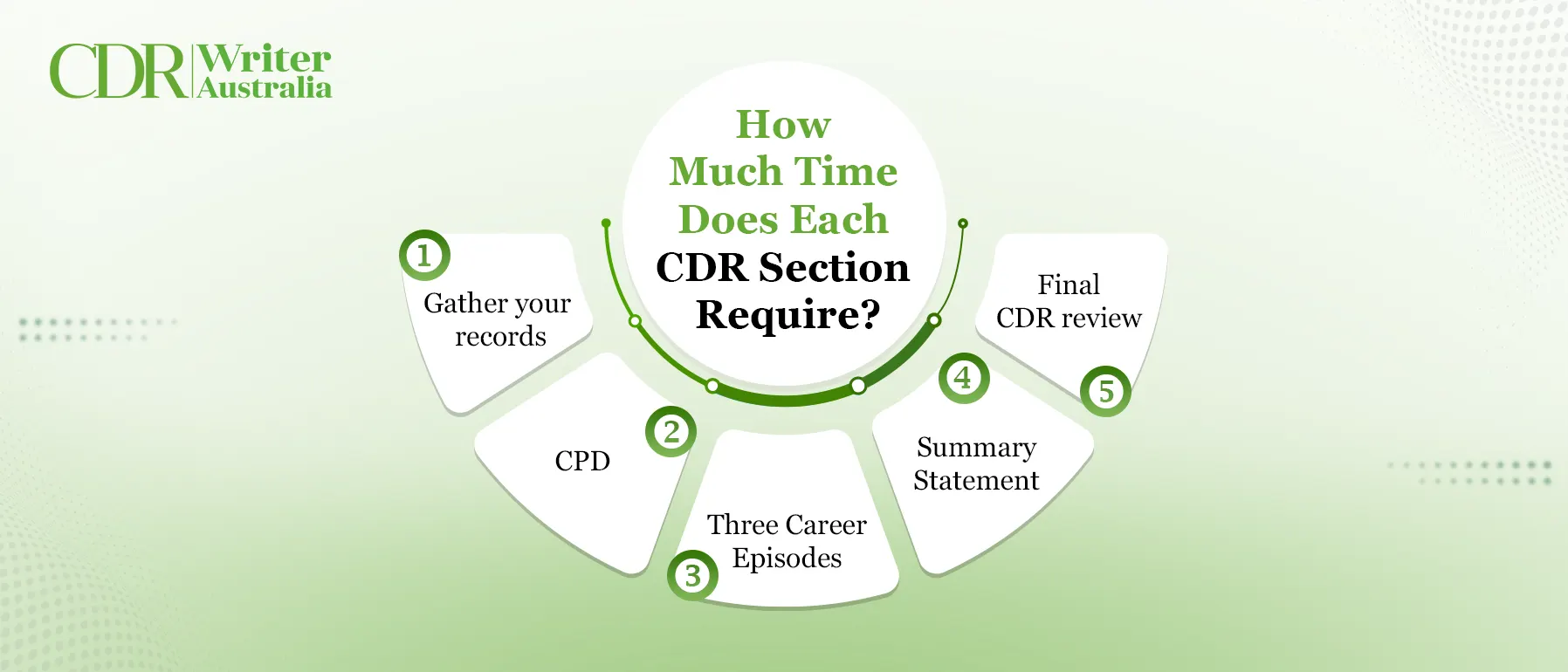
| Order | Preparation Stage | Practical Time Estimate | What You Should Prepare |
|---|---|---|---|
| 1 | Gather your records | 1–3 days | Collect project dates, duties, calculations, drawings, outcomes, qualifications, and employment evidence. |
| 2 | CPD | 1–2 days | Organise courses, seminars, workshops, conferences, technical reading, dates, and activity durations. |
| 3 | Three Career Episodes | 1–3 weeks | Describe your engineering actions, decisions, challenges, technical work, and project outcomes. |
| 4 | Summary Statement | 2–4 days | Map competency elements to the correct numbered paragraphs in your completed Career Episodes. |
| 5 | Final CDR review | 1–3 days | Check accuracy, consistency, formatting, paragraph references, grammar, and supporting documents. |
Read: How to Write a Summary Statement for Professional Engineers?
What Determines Your CDR Preparation Time?
Your CDR preparation time depends on your project records, technical clarity, and available writing time. Missing information can quickly extend several stages.
1. Availability of Project Records: Complete records help you recall project dates, responsibilities, calculations, and outcomes accurately. Missing evidence can force you to pause and verify details.
2. Complexity of Your Engineering Projects: Complex projects often need more explanation, especially when they involve several systems, decisions, or technical challenges. You may also need extra supporting evidence.
3. Clarity of Your Personal Engineering Work: Your Career Episodes must focus on the engineering work you personally completed. Unclear responsibilities can make your drafting and competency mapping harder.
4. Time Available for CDR Preparation: Work, family, and other commitments may limit your writing time. A realistic schedule helps you maintain progress without rushing important sections.
5. Competency Mapping and Paragraph Numbering: You must map competency elements to numbered Career Episode paragraphs. Incorrect references can create extra checking and revision work.
6. Number of Revisions Required: Repeated changes can extend your CDR completion time. A clear structure and organised evidence help you reduce unnecessary revisions.
Also Read: How to Write a Perfect CV for Engineers Australia?
How Can You Plan Your CDR Preparation Timeline?
You can plan your CDR preparation timeline by completing each stage in the right order. This approach keeps your work organised and reduces avoidable delays.
Start with the evidence behind your engineering work. Bring together project dates, duties, calculations, drawings, challenges, and outcomes.
These records will shape your Career Episodes later. Strong preparation here saves time when drafting technical details.
Before writing, check the latest Engineers Australia guidance. Focus on required sections, word limits, paragraph numbering, and competency elements.
This step gives the entire report a clear direction. It also prevents major structural changes after drafting begins.
Next, organise your professional development activities. Include courses, seminars, workshops, conferences, technical reading, dates, and durations.
A complete record makes the CPD statement easier to finalise. It also prevents missing activities from surfacing during review.
Work through one Career Episode at a time. Describe your actions, engineering decisions, technical challenges, and project outcomes.
Finish all three Career Episodes before starting the Summary Statement. Their final paragraph numbers will guide your competency references.
Then connect each competency element to the correct paragraph. Accurate mapping reduces confusion during the final review.
Check dates, project details, paragraph references, formatting, and language. Compare your CDR with your CV and supporting records.
While writing your CDR, make sure your CV and employment evidence match the report. Consistent information strengthens the overall presentation.
Reserve extra time for missing evidence or unclear technical sections. Final corrections can prevent rushed changes before submission.
A small time buffer keeps the final review calm and controlled. It also prevents rushed corrections near your intended deadline.
Note:Engineers Australia does not set a fixed CDR preparation timeframe. Therefore, adjust this plan around your records, workload, and revision needs.
Can a CDR Review Reduce Your Preparation Time?
Get focused feedback on gaps, structure, competency mapping, and consistency. Revise your self-written CDR with clearer direction.
Talk to an ExpertWhat Can Delay Your CDR Preparation?
Your CDR preparation can slow down when project records are incomplete, responsibilities remain unclear, or sections require repeated revisions. Small gaps often create delays that affect every stage that follows.
1. Missing Project Records: Incomplete dates, calculations, drawings, or outcomes can interrupt Career Episode drafting. Reconstructing old project details often takes additional time.
2. Unclear Personal Contributions: Vague responsibilities make it difficult to explain your individual engineering work. They can also weaken competency mapping and require further clarification.
3. Choosing Unsuitable Projects: Projects with limited technical depth may not support enough competency evidence. Changing a project later can significantly extend your preparation timeline.
4. Inconsistent Information: Differences across your CDR, CV, references, and employment records create extra checking. Correcting timelines and responsibilities can delay finalisation.
5. Starting the Summary Statement Too Early: Career Episode edits can change paragraph numbers and competency references. Early mapping may therefore require repeated corrections.
6. Rushing the Drafting Process: A rushed draft often contains missing explanations, weak examples, and formatting errors. These issues increase the time required for final review.
7. Delaying the Final Review: Leaving checks until the intended submission date creates unnecessary pressure. A time buffer allows careful corrections without disrupting your plans.
Also Read: CDR Report Writing Mistakes to Avoid At All Costs
Know the Difference Between CDR Preparation and Assessment Time
CDR preparation and assessment processing happen at different stages.First, you prepare and finalise your CDR before submission. Once Engineers Australia receives it, the assessment processing stage begins.
| Timeline | When It Happens | What It Covers |
|---|---|---|
| CDR preparation time | Before submission | Gathering records, preparing CPD, drafting Career Episodes, mapping competencies, and completing final checks. |
| Assessment processing time | After submission | Engineers Australia reviews your qualifications, CDR documents, competencies, and supporting evidence. |
Also Read: Engineers Australia Assessment Fees: Cost & Charges Guide
Key Takeaways
Frequently Asked Questions
Start your CDR several weeks before submission, once you confirm your projects, records, and assessment pathway. This gives you time to draft, map competencies, and fix missing details.
Yes, you can complete a CDR in one week when you already have organised records and clear project details. However, this leaves little time for revisions, competency mapping, and final checks.
Prepare your CV, qualifications, employment records, CPD details, project documents, calculations, drawings, and key project dates. These records help you describe your work accurately and avoid delays.
A CDR review can save time by finding unclear sections, missing evidence, and incorrect competency references early. Clear feedback helps you revise the right areas without checking the entire report repeatedly.
Allow at least two to three days for final CDR checks. Review dates, project details, competency references, formatting, grammar, and supporting documents during this time.


