
Engineering New Zealand Knowledge Assessment for Migration
17 minute read
Publish date: 2026/05/25
Planning to use your engineering qualification for New Zealand migration but confused about where to start? Many applicants struggle to understand whether their degree is recognised, whether they need a knowledge assessment, and which pathway fits their background.
That is where the Engineering New Zealand Knowledge Assessment becomes important. It gives applicants a clearer way to understand where their qualification stands before moving further with skilled migration.
In this blog, we explain the Engineering New Zealand Knowledge Assessment, who needs it, how KA01 and KA02 differ, and what applicants should prepare.
What Is the Engineering New Zealand Knowledge Assessment?
The Engineering New Zealand Knowledge Assessment, formerly known as the IPENZ assessment, is a formal review of an overseas engineering qualification against New Zealand’s expected engineering knowledge standard.
This assessment usually applies when an overseas qualification needs review outside a recognised engineering accord pathway, such as the Washington Accord, Sydney Accord, or Dublin Accord. It can also support skilled migration, KA02 applications, Chartered pathways, and some Engineering New Zealand membership routes. It gives migration applicants a clearer way to show that their engineering education meets New Zealand’s expected knowledge standard.
What Are the Engineering New Zealand Assessment Pathways?
Engineering New Zealand uses KA01 and KA02 to assess overseas engineering qualifications. KA01 suits recognised qualifications, while KA02 suits qualifications that need deeper evidence.
1. KA01 Assessment
KA01 Assessment applies to applicants whose engineering qualification is recognised through an accepted engineering accord pathway. This may include qualifications accredited under the Washington Accord, Sydney Accord, or Dublin Accord.
Applicants usually choose KA01 when their certificate, transcript, institution details, and accord recognition can confirm their education level. This pathway focuses on recognised academic qualifications rather than project-based evidence.
2. KA02 Assessment
KA02 Assessment applies when the qualification needs a deeper review of engineering knowledge. Applicants usually use KA02 when their qualification falls outside an accepted accord pathway or needs more evidence.
As part of this review, applicants may submit work episodes, also called work samples or work records. These show how they applied engineering knowledge in real projects. Engineering New Zealand recommends including up to four work samples where needed, supported by documents such as calculations, drawings, design documents, reports, or project records.
| Category | KA01 Assessment | KA02 Assessment |
|---|---|---|
| Who It Applies To | Applicants use KA01 when their qualification comes from a recognised engineering accredited pathway. | Applicants use KA02 when their qualifications require a detailed engineering knowledge review. |
| What It Checks | Qualification recognition and the accepted engineering education standard. | Academic learning, engineering knowledge, and project-based evidence. |
| Evidence Usually Needed | Qualification certificates, transcripts, and accord recognition evidence. | Academic records, course details, project examples, and technical reports. |
What Key Areas Does Engineering New Zealand Assess?
Engineering New Zealand looks beyond the qualification title during assessment. The key areas include engineering knowledge, problem-solving ability, technical responsibility, communication, and work experience relevance.
Shows whether the applicant understands the technical principles behind their specific occupation field. Strong evidence may include design methods, calculations, engineering systems, materials, and standards used in real project work.
Comes through in how the applicant handled a technical issue. The evidence should show the problem, the analysis method, decision made, and final result.
Checks the engineering tasks the applicant handled personally. This can include design decisions, calculations, testing, safety checks, reporting, or project coordination.
Helps the assessor understand the applicant’s technical work without guessing. Project examples should explain engineering decisions in a structured and easy-to-follow way.
Connects the applicant’s projects with the claimed engineering discipline. The submitted examples should support the qualification, pathway, and engineering role clearly.
Documents Required for Engineering New Zealand Knowledge Assessment
Engineering New Zealand assessment usually requires identity, academic, employment, project, and CV records. You may also need extra supporting records if your documents need more clarification.
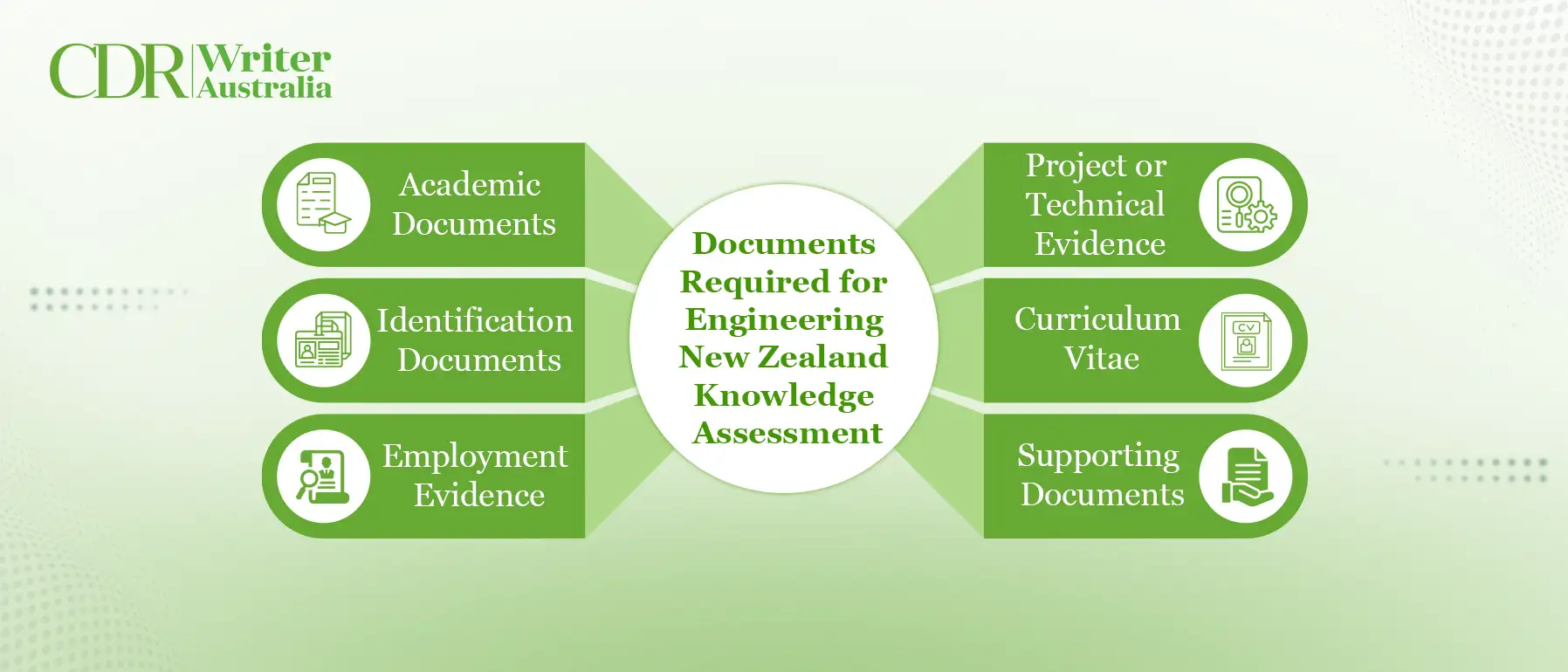
1. Academic Documents
Academic documents help show the applicant’s engineering study background and qualification level. They also help compare the completed course with New Zealand’s expected engineering education standard.
Required documents:
- Degree certificate
- Academic transcripts
- Course outlines
- Subject descriptions
2. Identification Documents
Personal identity records confirm the applicant’s legal name, date of birth, passport details, and any name changes. They help ensure the assessment profile matches the applicant’s academic, employment, and migration records.
Required documents:
- Passport
- National identity card, if available
- Birth certificate, if required
- Name change document, if applicable
3. Employment Evidence
Work records show the applicant’s engineering role, employment period, job responsibilities, and project involvement. They help connect the applicant’s work history with the claimed engineering background.
Required documents:
- Employment reference letters
- Job descriptions
- Work contracts
- Payslips, if required
- Project involvement records
4. Project or Technical Evidence
Project records show how the applicant applied engineering knowledge in real work or study. They help explain technical tasks, design decisions, calculations, problem-solving steps, and project outcomes.
Required documents:
- Project reports
- Technical reports
- Design documents
- Calculations
- Drawings or diagrams
- Project summaries
5. Curriculum Vitae
A clear CV presents the applicant’s education, employment history, engineering roles, and project timeline in one place. It helps reviewers understand the applicant’s background before checking detailed evidence.
Required documents:
- Updated CV
- Education history
- Employment history
- Project experience
- Technical skills summary
6. Supporting Documents
Additional records help explain gaps, name changes, translation issues, or special qualification details. They make the application easier to verify when the main documents need extra context.
Required documents:
- Certified translations
- Name change documents
- Accord recognition evidence
- Course content documents
- Extra documents requested during review
Also Read: Complete Document Checklist for ACS Skill Assessment
How Does the Engineering New Zealand Assessment Work?
Engineering New Zealand assessment starts with checking eligibility and preparing evidence, then moves into online submission and validation. After that, assessors review the application, evaluate the evidence, and share the final decision.
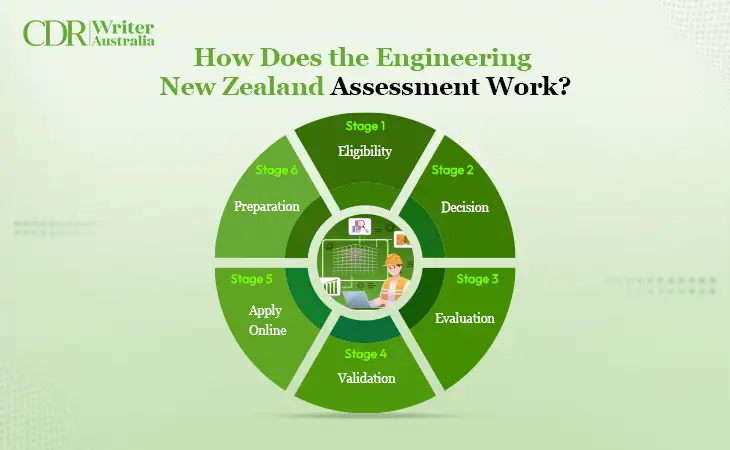
Stage 1: Eligibility
Check whether the qualification meets the required standard or whether equivalent engineering knowledge can support the application. For a Chartered engineer (CPEng), this usually means a Washington Accord-accredited qualification or evidence of equivalent knowledge.
Stage 2: Preparation
Prepare evidence that shows competent engineering practice in the selected practice area. Many engineers build this experience over four to six years before applying for CPEng.
Stage 3: Apply Online
Complete the online application form and upload the required documents. Engineering New Zealand may publish the applicant’s name during assessment and invite public feedback.
Stage 4: Validation
A Competence Assessment Advisor checks the submitted information before panel review. The advisor may request changes or extra details before sending the application to an Assessment Panel.
Stage 5: Evaluation
An Assessment Panel reviews the final application and supporting evidence. The panel may meet with the applicant to discuss the evidence, practice area, and competence claims.
Stage 6: Decision
The advisor shares the proposed outcome after the panel review. Successful applicants may appear on the public register, while unsuccessful applicants can respond if the assessment decision allows a response.
Note: For writing reference, you can view our CDR report samples to understand the report structure, project explanation style, and technical evidence presentation.
Common Engineering New Zealand Assessment Delays and Negative Outcomes
Engineering New Zealand assessment delays usually happen when the application leaves gaps in academic records, course content, or project evidence. On top of that, weak KA02 explanations, late advisor replies, blurry scans, and unclear translations can make the evidence harder to verify.
1. Incomplete Application Details: Missing practice area, qualification history, employment timeline, or pathway details make the application difficult to validate.
2. Missing Academic Transcripts: Assessors need transcripts to check completed subjects, grades, credit hours, and qualification level.
3. Unclear Course Content Evidence: Weak course descriptions make it harder to compare engineering subjects with New Zealand’s expected knowledge standard.
4. Incomplete Project Evidence: Limited project details leave the engineering task, personal role, technical decisions, and outcome unclear.
5. Unclear KA02 Technical Explanation: Poorly explained calculations, analysis methods, and problem-solving steps weaken the knowledge evidence.
6. Delayed Response to Advisor Feedback: Late replies pause the assessment until the requested corrections or documents arrive.
7. Poor Document Quality or Translation Issues: Blurry scans or unclear translations make names, dates, qualifications, and project details harder to verify.
Preparing for Engineering New Zealand assessment?
Let CDR Writer Australia help you organise your KA02 work samples, technical evidence, and documents.
Contact usKey Takeaways
Table of Content
- What Is the Engineering New Zealand Knowledge Assessment?
- What Are the Engineering New Zealand Pathways?
- What Key Areas Does Engineering New Zealand Assess?
- Documents Required for Engineering New Zealand
- How Does the Engineering New Zealand Assessment Work?
- Common Engineering New Zealand Assessment Delays and Negative Outcomes
- Key Takeaways
- FAQs
Frequently Asked Questions
The Knowledge Assessment checks your engineering qualification, whereas Engineering New Zealand reviews your degree, subjects, transcripts, and course content to see whether your education meets New Zealand’s engineering knowledge standard.
Yes, you can apply for KA02 with limited work experience; all you need is strong academic evidence. These documents must show that you studied and applied engineering principles.
No, KA02 work samples and CDR career episodes are different documents. Engineering New Zealand uses KA02 work samples to assess engineering knowledge. Engineers Australia uses CDR career episodes for migration skill assessment.
Yes, Engineering New Zealand can ask for extra documents after submission. This usually happens when transcripts, course descriptions, identity records, employment letters, project reports, or work samples do not give enough proof for assessment.
No, submit only your strongest and most relevant projects. Choose work samples that clearly show your engineering task, personal role, technical problem, calculations, design decisions, and project result. A few strong work samples are better than several weak project summaries.

