Requirements to Migrate to Australia
13 minute read
Publish date: 2024/10/2
If you are planning to migrate to Australia, it is essential to understand the requirements set by the Australian government for an effective migration.
Australia has its unique standards from visas and qualifications to financial considerations. Careful planning and organisation are key to ensuring a successful migration experience. There are several key steps to ensure your relocation is a smooth one.
So, without further delay, let's dive into the requirements to migrate to Australia.
What are the Requirements to Move to Australia?
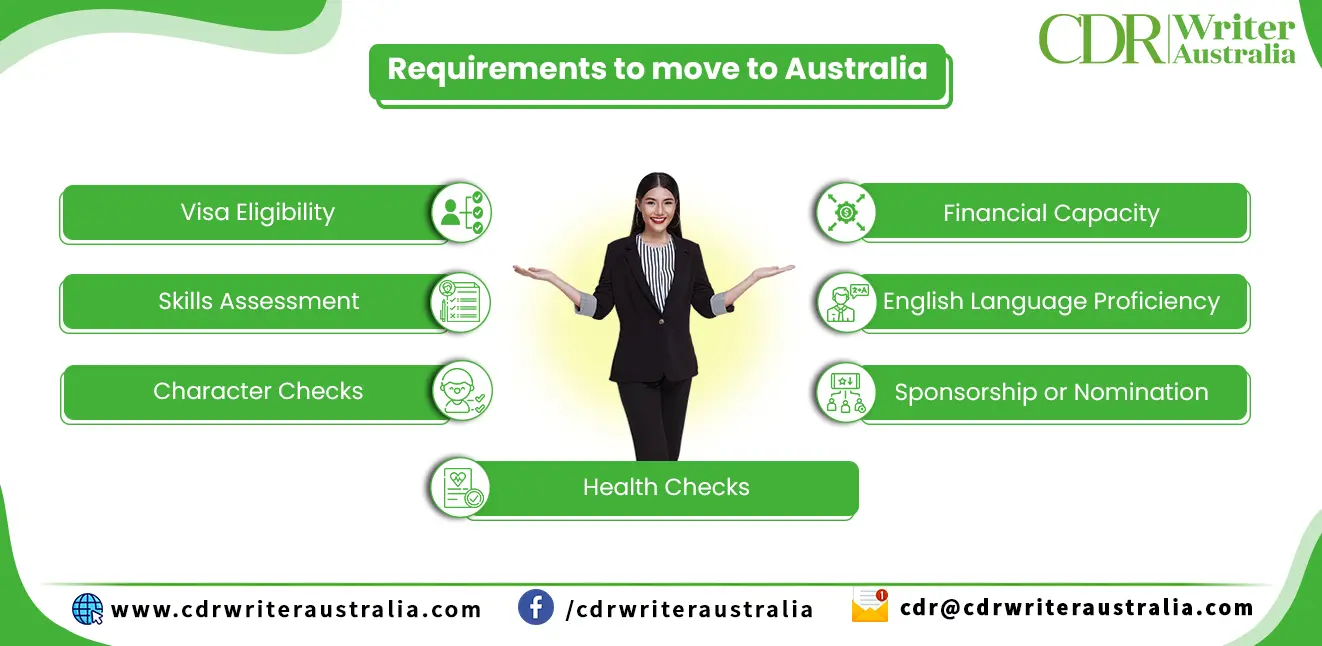
Here are the essential requirements to migrate to Australia:
1. Visa Eligibility
Australia's migration requirements vary depending on the type of visa you choose.
Before you apply for a visa, it is important to understand the visa categories (i.e. work, study, family reunion and skilled migration) and their eligibility conditions.
The following table provides the summarised details on types of visa and eligibility conditions to move to Australia:
| S.N | Types of Visa | Eligibility condition | Length of stay | Age limit |
|---|---|---|---|---|
| 1. | Work visa | Australian management sponsors the one who meets the specific skill benchmarks. | 2 - 4 years | ≤45 years of age. |
| 2. | Skilled visa | Apply a point system based on age, qualification and work experience. | Granted permanent residency visa | At least 18 years and less than 50 years of age. |
| 3. | Student visa | Require specific academic qualifications with financial support for your stay. | Depends on different student visa types | Above 18 years of age. |
| 4. | Family and Spouse visa | It depends on your relationship with sponsoring family members. | Temporary or permanent visa granted allowing indefinite stay in Australia. | No age limit |
| 5. | Business visa | Depends on the specific business activity, with various terms and conditions applied. | Initially granted for 4 years | Age under 55 years of age. |
Note: Assess your eligibility for different visas to make an informed decision.
2. Skills Assessment
The skill assessment ensures that your education and job history meet Australian standards, which is a key step in meeting the requirements to migrate to Australia.
In general, the skill assessment process includes the following steps:
Step 1: Find the assessing body that assesses your skills.
Step 2: Examine the specific criteria for qualifications and experience needed for the job you applied for.
Step 3: Compile a report detailing your skills and work experience.
For example: skilled Engineers who graduated from non-credential educational institutions should submit a Competency Demonstration Report (CDR) to Engineers Australia.
Step 4: Submit additional documents like transcripts, certificates, reference letters, or proof of work experience.
Step 5: Submit your application and required documents to the assessing body through an online portal or physical mailing.
After completing the following steps, the assessing body evaluates your documents. The official outcome might be positive or negative. Sometimes, you might get remarked as “further assessment required” or “rejected” if your documents are insufficient.
Are you looking for the best CDR writers in Australia?
CDR Writer Australia is here!
We prepare your report strictly according to EA guidelines.
Contact Us3. English Language Proficiency
English language proficiency is an essential requirement to migrate to Australia. Migrants must achieve a certain score depending on the visa subclass and individual circumstances.
When considering the requirements to migrate to Australia, demonstrating proficiency in the English language is a key factor. This is typically achieved through different standardised tests. Here is the minimum score including the score for each band.
| English Language Proficiency Test | Minimum Score |
|---|---|
| IELTS (International English Language Testing System) | At least 6 for each band. |
| TOEFL (Test of English as a Foreign Language ) | At least 12 for listening, 13 for reading, 21 for writing and 18 for speaking |
| PTE ( Pearson Test of English Academic) | At least 50 for each of the 4 bands |
| OET (Occupational English Test) | At least B for each of the 4 bands |
| CAE ( Cambridge Advanced English) | At least 169 in each of the 4 bands |
If you lie under the following categories, you can skip an English language proficiency test:
- Migrants with citizenship in English-speaking countries such as the United Kingdom, Canada, the United States, New Zealand, or Ireland.
- Migrants who have completed a recognised qualification where the medium of instruction was English.
- Evidence of substantial work experience in an English-speaking environment, etc.
4. Health Checks
The health check is done to identify medical issues that might keep Australian public health at risk.
Additionally, healthy immigrants are more likely to be able to work full-time and contribute to their full potential. This strengthens the workforce and boosts the economy.
Here’s a brief description of Migration Health Assessment, by Age of the Applicant:
| Age of an applicant | Medical examination |
|---|---|
| 2 - 4 years of age | Blood or skin test for tuberculosis |
| 5 - 10 years of age | Urine analysis; blood or skin test for tuberculosis |
| 11 -14 years of age | Urine analysis; chest X-ray |
| ≥ 15 years of age | Urine analysis; chest X-ray; laboratory blood tests |
If you are examined with the following diseases your visa might get rejected,
- Measles outbreaks,
- Tuberculosis,
- HIV and hepatitis,
- Yellow fever,
- Polio,
- Ebola virus disease and many more.
These health assessments are conducted to ensure that applicants meet the requirements to migrate to Australia without posing a risk to the nation's public health system.
Note: Visas may be granted, if Australia has sufficient resources to treat the disease. Migrants must provide documented evidence of treatment plans and health insurance.
5. Character Checks
Character checks are conducted to determine your involvement in criminal activities, directly or indirectly. The assessment ensures migrants are trustworthy while living in Australia.
Here are some key Australia migration requirements for character checks:
- Migrants must provide biometric data including fingerprints and a photograph for identification purposes.
- There must be police clearance certificates from all countries you have lived in for 12 months or more in the past 10 years.
- The certificates must be valid, 12 months from the date they are issued at the time of application for police certificates.
Note: A migrant's criminal history can result in visa rejection. This could also impact the visa applications of dependents, including spouses and children.
6. Financial Capacity
Australia has set specific criteria to meet the financial capacity for a successful visa application. The financial requirements depend on the visa type.
If you can show sufficient resources, it will significantly improve your chances of a successful visa grant.
However, you should carry sufficient funds to cover expenses like accommodation, transportation, and cost of living.
For example, the Australian government has set direct requirements on a student visa for financial resources. If you are migrating to Australia for study purposes, you need evidence of having enough funds to cover living expenses for a year. (Minimum AU$24,505 for a single person as of May 2024).
Also, check out: Studying in Australia
7. Sponsorship or Nomination
In Australia, government agencies, employers and family members can provide sponsorship or nomination to the migrants. It helps Australia to fill the skill shortages with global talent. Therefore, migrants must meet the requirements to migrate to Australia, which often include having the right skills and, in some cases, passing specific skill assessments aligned with market demands.
Migrants can apply for sponsorship or nomination under three categories.
1. Skilled Sponsorship Visas:
Skilled Sponsorship Visas are designed for skilled workers to sponsor an eligible Australian employer, state, or territory government.
You can apply for skilled Sponsorship visas under:
- 482 Temporary Skills Shortage visa
- 186 Employer Nomination Scheme visa.
2. Employer-Sponsored Visas:
Employer-sponsored visas allow Australian employers to sponsor skilled workers from overseas to fill job vacancies.
Employers must receive approval from the Australian government to act as sponsors and prove that local candidates are incapable of the specific job.
Some visas you can apply for employer-sponsored visas are:
- Employer Nomination Scheme (Subclass 186),
- Temporary Skill Shortage Visa (Subclass 482),
- Skilled Employer Sponsored Visa (Subclass 494),
- Training Visa (Subclass 407),
- Temporary Work Visa (Subclass 457)
3. Other Sponsorship Visa Options
Other Sponsorship visa options provide opportunities for childcare educators and teachers, research and administrative positions, and registered nurses. They play a crucial role in the Australian workforce.
You can apply for sponsorship under the following sub-classes of visas:
- Skilled Independent Subclass 189 visa,
- Temporary Skill Shortage visa (subclass 482),
- Skilled Employer Sponsored visa,
- Temporary Skill Shortage visa
An eligible sponsor must cover any associated fees before sponsoring the migrants. These include application processing fees, sponsorship fees, or other expenses related to the visa application process.
Key Takeaways
Table of Content
Frequently Asked Questions
Legal requirements for moving to Australia include genuine documents of approved visa, health and character set by Australia.
Yes, work experience is typically mandatory for skill assessments in Australia, particularly for applicants seeking skilled migration. The work experience requirements vary depending on the occupation and the assessing authority.
Yes. You can move to Australia without a job, you can get a visa based on your eligibility. Also read: Working in Australia.
No, you cannot apply for permanent residency immediately after arriving in Australia. You must meet specific requirements depending on your visa type.
What did you think of the article? Anything you agree or disagree with? We would love to hear your thoughts.
Lets Chat